The Erebus disaster
- When
- 28 November 1979
- Where
- Departed Auckland Airport · Tāmaki Makaurau
- Reach
- Nationwide
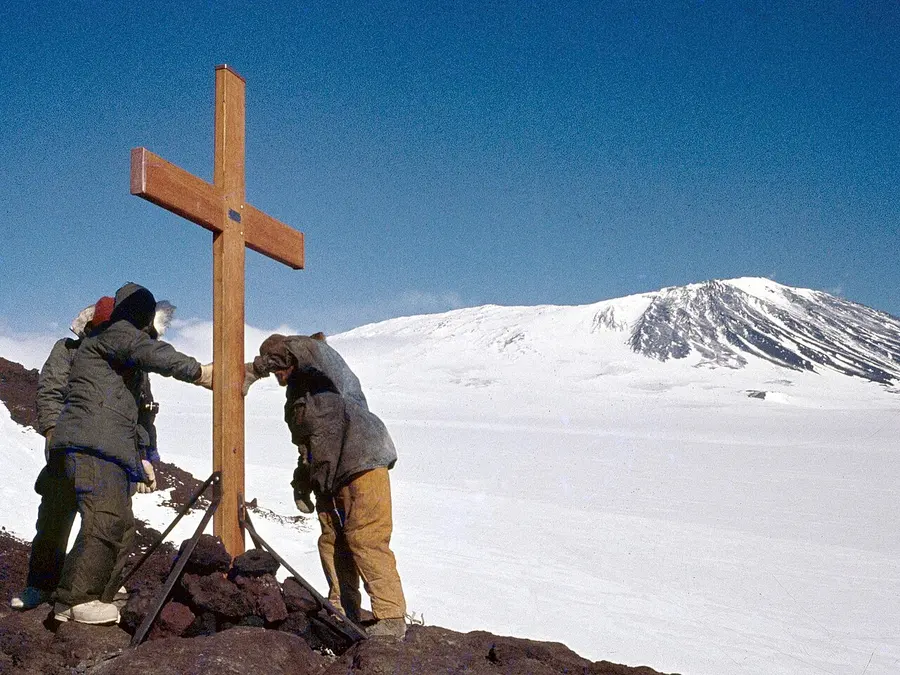
An Air New Zealand sightseeing flight to Antarctica flew into Mount Erebus in whiteout conditions. All 257 people aboard died.
Air New Zealand and Qantas began offering sightseeing flights to Antarctica in February 1977. The flights proved popular, and Air New Zealand needed to do little advertising to fill the seats on those it announced for November 1979. The airline offered meals and refreshments, a complimentary bar service, in-flight entertainment and expert commentary. On 9 November 1979 Captain Jim Collins and First Officer Greg Cassin, rostered on the 28 November flight, attended a route qualification briefing. It covered the instrument flight route to the McMurdo area, which set a minimum altitude of 16,000 feet when flying on instruments, and a procedure that allowed them to descend to 6,000 feet over McMurdo if visibility was good. Material presented at the briefing gave the impression that the route would take them down McMurdo Sound over flat sea ice.
In the early hours of 28 November, the airline's navigation section changed a navigational coordinate in the flight plan. It believed it was making a minor adjustment, but a typing error 14 months earlier meant the change shifted the flight's destination point 27 nautical miles to the east. Instead of taking Flight TE901 over sea ice, the route would now take it directly over Mt Erebus, a 3,794-metre active volcano. The flight crew were not told of the change, and that morning they entered the new coordinates into the onboard computer. The McDonnell Douglas DC-10 left Māngere airport, Auckland, shortly before 8.30 a.m. New Zealand daylight time. At 12.45 p.m. NZST Cassin told air traffic control at McMurdo Station that the aircraft was descending to 2,000 feet in visual conditions. It was the last message from TE901. Four minutes and 42 seconds later, at 12.49 p.m., the aircraft crashed into the lower slopes of Mt Erebus, killing all 237 passengers and 20 crew. Te Ara notes that the official accident report found the aircraft had been flying in whiteout conditions, in which sunlight filtered through cloud and reflected off the snow made it impossible to tell ground from air.
Wreckage was sighted at midnight NZST, and the next day three New Zealand mountaineers lowered onto the site by US Navy helicopters confirmed that there were no survivors. In the recovery and identification effort known as Operation Overdue, police, investigators and mountaineers recovered the flight recorders, 114 substantially intact bodies and 133 bags of human remains; 213 of the 257 victims were eventually identified. The chief inspector of air accidents, Ron Chippindale, concluded that the flight would have proceeded safely had the pilot not descended below the minimum safe altitudes. Many read this as a finding of 'pilot error', although that term was never officially used.
Justice Peter Mahon's Royal Commission of Inquiry, whose report was released in April 1981, disagreed with Chippindale. Mahon cleared the crew of any responsibility and laid the blame squarely on Air New Zealand. He also accused the airline's executives and management pilots of covering up evidence and misleading investigators through 'an orchestrated litany of lies'. The Court of Appeal found that in making that accusation Mahon had breached natural justice and acted outside his jurisdiction, and it quashed his costs order against the airline. Mahon resigned from the High Court bench, and in 1983 the Privy Council dismissed his appeal. Neither court case dealt with his findings on the cause of the crash.
NZHistory calls the crash the worst civil disaster in New Zealand's history; Wikipedia calls it the country's deadliest peacetime disaster. Air New Zealand ended its Antarctic flights immediately, and Qantas stopped in February 1980; between them the airlines had carried about 10,000 passengers to Antarctica. The Mahon report was not tabled in Parliament until 1999. In 2009 Air New Zealand's chief executive, Rob Fyfe, apologised to those the airline had let down in the aftermath, but for many that did not go far enough. On the 40th anniversary in 2019 the Prime Minister, Jacinda Ardern, apologised on behalf of the government for the actions of an airline then in full state ownership, and confirmed that the pilots were not responsible. The Air New Zealand chair, Therese Walsh, apologised for an airline that had 'failed its duty of care'. NZHistory notes that the debate over whether pilot error or Air New Zealand was to blame continues.
The defining moments of New Zealand, on one poster. Get your digital print for $25
Regions affected
Sources
Written for this project from these references rather than copied from them. Follow a link to read the full account, or to check this one against the original.
Related
The influenza pandemic
About 9,000 people died in two months — roughly half as many as died in four years of war. Māori died at more than eight times the Pākehā rate.
The Springbok tour
Fifty-six days that split the country. Protesters occupied the pitch at Hamilton and stopped the game; by the final test, police in riot gear fought crowds outside Eden Park.
Rugby Park, HamiltonRogernomics — the economy is deregulated
A Labour government floated the dollar, removed farm subsidies and tariffs, and sold state assets in a radical programme of market liberalisation.
The 1987 sharemarket crash
The New Zealand market fell further than almost any other and took years longer to recover, badly burning many small ‘mum and dad’ investors.
Auckland