William Hobson is sent to negotiate a treaty
- When
- 14 August 1839
- Reach
- Nationwide
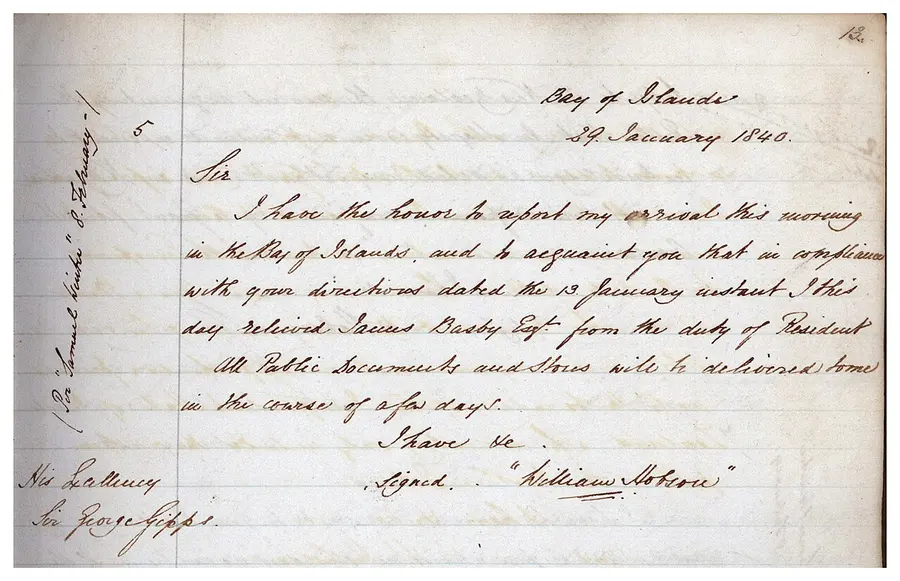
The Colonial Office instructed Hobson to obtain the free and intelligent consent of Māori to British sovereignty — the brief that produced Te Tiriti six months later.
For most of the 1830s London avoided taking on New Zealand. The option officials favoured was Hobson's own 1837 proposal of British 'factories', enclaves of British authority around settlements, and late in 1838 Lord Glenelg decided to send a consul. Hobson accepted the post in February 1839. The New Zealand Company forced the pace. Warned that the government would keep a monopoly over land purchases, Edward Gibbon Wakefield urged his colleagues to send an expedition immediately and acquire all the land they could, and the Tory sailed in May. Officials now moved fast. Letters patent of 15 June 1839 allowed any territory acquired in New Zealand to be joined to New South Wales, whose government could then run it.
The instructions were drafted by James Stephen, the Colonial Office's permanent under-secretary, and issued on 14 August 1839 over the name of Lord Normanby, who had succeeded Glenelg. They began by setting out New Zealand's value to Britain, then said ministers had held back for 'higher motives' and changed course only with 'extreme reluctance', because over 2,000 British subjects were living there out of reach of any law. Normanby acknowledged New Zealand as 'a sovereign and independent state', then qualified it in the same sentence by describing Māori as scattered tribes unable to act in concert. The Queen would not claim the islands unless 'the free and intelligent consent of the natives' was obtained first. Hobson was to treat for sovereignty over 'the whole or any parts' of the country, explaining frankly the protection Māori would gain.
The same document set the land policy. Normanby did not use the word pre-emption, but he told Hobson to persuade chiefs that land would in future be sold only to the Crown, and to proclaim that no title would stand unless it came from a Crown grant. Earlier purchases would go before a commission. The Crown would buy cheaply and resell to settlers, funding further purchases and emigration, while avoiding land that Māori needed for their own subsistence. In a letter the next day, answering Hobson's questions, Normanby agreed that if the South Island held only a few people unable to enter a treaty with any understanding, Hobson could claim sovereignty there on the ground of discovery.
Early historians praised the instructions. T L Buick called them 'statesman-like', and earlier Tribunals treated them as essential for reading the treaty. Later writers were cooler. Peter Adams argued that Māori 'were to be told only half the story', hearing that Britain was stepping in to protect them but not that it also meant to protect settlers' interests, and Claudia Orange called Normanby's insistence on Māori rights deceptive. In its 2014 stage 1 Te Paparahi o Te Raki report, the Waitangi Tribunal concluded that Britain went into the negotiation intending to gain the power to make law over Māori and Pākehā alike. Hobson, it found, did not explain this. Consistent with his instructions, he presented Britain's aim as restraining Pākehā so that Māori would be protected. It found that the rangatira who signed in February 1840 did not cede sovereignty, contrary to the Crown's submission that they had.
The defining moments of New Zealand, on one poster. Get your digital print for $25
Regions affected
Sources
Written for this project from these references rather than copied from them. Follow a link to read the full account, or to check this one against the original.
Related
Te Tiriti o Waitangi is signed
Te Tiriti o Waitangi
Around 540 rangatira signed Te Tiriti at Waitangi and at more than 50 meetings around the country. The English and te reo Māori texts do not say the same thing, and never have.
WaitangiHe Whakaputanga — Declaration of Independence
He Whakaputanga o te Rangatiratanga o Nu Tireni
Rangatira of the United Tribes declared New Zealand an independent state, with sovereignty and authority over the land resting with the rangatira.
WaitangiNorthern chiefs petition King William IV
Thirteen rangatira asked the King to be a friend and guardian of these islands, worried by runaway sailors and other troublesome Europeans, and by rumours of French designs.
KerikeriThe Native Land Court is established
The court converted customary communal title into individual titles that could be sold, and became the main means by which most remaining Māori land passed out of Māori ownership.