Hongi Hika travels to England
- When
- 1820
- Where
- Bay of Islands · Pēwhairangi
- Reach
- Local
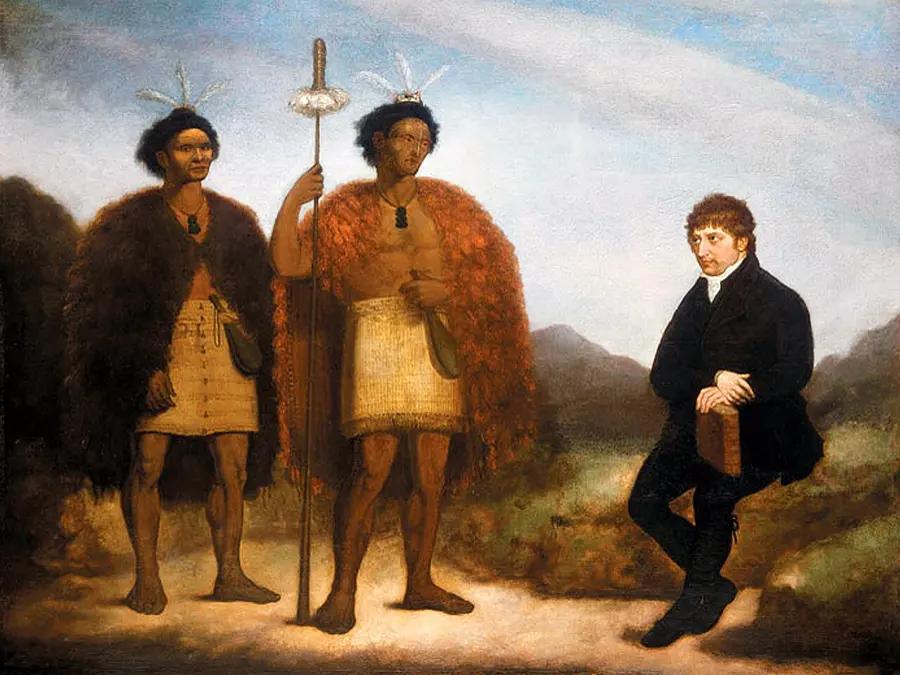
The Ngāpuhi leader met King George IV in London, then traded most of the gifts he received for muskets on the return journey through Sydney.
Born near Kaikohe, by his own reckoning in 1772, Hongi Hika became war leader of his Ngāpuhi people after their defeat by Ngāti Whātua at Moremonui in 1807 or 1808. There Ngāpuhi carrying a few muskets were ambushed while they reloaded, and two of Hongi's brothers were killed; he survived by lying hidden in a swamp. He came away obliged to avenge the loss, and later campaigns in the north convinced him that guns would decide battles if used in enough numbers. By 1815 no one disputed his leadership. He protected the Church Missionary Society mission from its start in 1814, because missionaries drew ships and ships meant trade. The missionaries, though, refused to sell him muskets or even repair them, so his people grew large crops of potatoes, much of it the work of captives from his southern campaigns, to buy guns and powder from visiting crews.
In 1820 Hongi sailed for England on the whaler New Zealander with the missionary Thomas Kendall and the younger Rangihoua chief Waikato. Kendall made the trip without the society's approval. He wanted to settle doubts that Samuel Lee, a Cambridge professor of oriental languages, had raised about his attempts to write Māori down. At Cambridge the two chiefs worked with Lee on A grammar and vocabulary of the language of New Zealand, published at the end of 1820, which laid the foundations of Māori spelling. In London and Cambridge the visitors were widely entertained, Hongi's moko (facial tattoo) attracted attention, and both chiefs met King George IV. James Barry painted the three men together.
Hongi himself was more interested in guns. He had heard of a 'thousand thousand guns' said to be kept in the Tower of London. Among the king's presents was a suit of armour. On the voyage home, in Sydney, he traded most of the other gifts for muskets but kept the armour. According to one account he also collected several hundred muskets ordered for him through Baron Charles de Thierry, whom he had met at Cambridge, along with powder, shot and blades. Estimates of the total run from 300 to 500 guns. The missionaries were dismayed. Hongi was home by July 1821.
The new arsenal shifted the balance of power. Other Bay of Islands communities bought guns to defend themselves from Hongi's hapū (sub-tribe), and the well-armed northern tribes turned on southern peoples with few or no guns. Within months Hongi attacked Ngāti Pāoa, led by Te Hīnaki, at Mauinaina pā (fortified village) beside the Tāmaki River. Two musket balls struck him, the armour saved him, and he gained a name for being invulnerable. Attacks on Ngāti Maru near Thames, on Waikato at Matakitaki in 1822, and on Te Arawa at Mokoia Island in 1823 followed. Together these campaigns set off wars and migrations that, through the 1820s and 1830s, moved peoples across almost the whole North Island. Hongi was shot through the chest in 1827 and died of the wound at Whangaroa in March 1828.
The defining moments of New Zealand, on one poster. Get your digital print for $25
Regions affected
Sources
Written for this project from these references rather than copied from them. Follow a link to read the full account, or to check this one against the original.
Related
James Busby arrives as British Resident
Britain’s first Resident in New Zealand arrived with a grand title, no troops, little money and no legal authority — remembered as a man-of-war without guns.
WaitangiThe flag of the United Tribes is chosen
About 25 northern rangatira selected a national flag so that New Zealand-built ships could be registered and trade legally.
WaitangiTe Kotahitanga — the Māori Parliament
Te Kotahitanga o Te Tiriti o Waitangi
A Māori parliament met from 1892 to 1902, seeking authority over Māori land and people under the Treaty of Waitangi and petitioning Parliament for recognition.
Waipatu, Hawke’s BayNew Zealand becomes a separate colony
New Zealand was detached from New South Wales and given its own Governor, Legislative Council and courts.