Hutt Valley and Whanganui campaigns
- When
- 1846–1848
- Where
- Hutt Valley · Te Awakairangi
- Reach
- Several regions
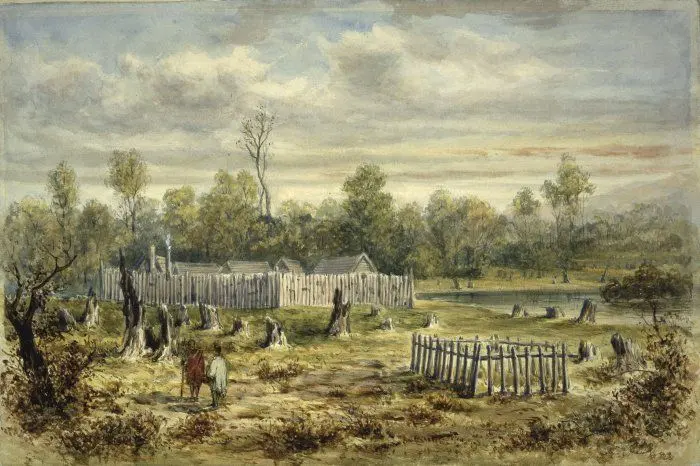
Fighting over disputed New Zealand Company purchases spread through the Hutt Valley in 1846 and up to Whanganui in 1847. Governor Grey had Te Rauparaha seized in a dawn raid and held without charge.
The New Zealand Company believed its 1839 deed with Te Ātiawa leaders at Petone had bought the land around Port Nicholson, including the Hutt Valley. Ngāti Toa, led by Te Rauparaha and his nephew Te Rangihaeata, saw themselves as the real power in the region and said no deal was valid without them. They had given Ngāti Rangatahi, originally from Whanganui, the right to live in the valley, and in 1841 and 1842 they encouraged Ngāti Rangatahi and Ngāti Tama to clear and plant it. In 1844 the land claims commissioner William Spain upheld part of the Company's claim. Te Rauparaha and Te Rangihaeata were paid another £400, but NZHistory notes that Ngāti Tama and Ngāti Rangatahi received neither land nor money. The Ngāti Tama chief Te Kāeaea cut a line through the bush to mark where settler land ended and theirs began, and Te Rangihaeata camped in the upper valley with 500 followers. Many settlers still wanted him punished for his part in the deaths of 22 settlers at Wairau in 1843.
With the Northern War over, Governor George Grey came to Wellington with troops in early 1846. Te Kāeaea promised to leave once his people were paid for some 300 acres of potatoes; Grey refused to discuss compensation until the land was empty. By late February the two iwi had gone. Settlers moved straight in, and the village of Maraenuku was destroyed, its chapel and urupā (burial ground) desecrated. The iwi came back and plundered settlers' houses. 'I thought the word of a Governor was sacred,' Te Kāeaea told the missionary Richard Taylor, 'but now I see that he too is worth nothing in the eyes of his own people.' Grey declared martial law on 3 March after a clash with troops near Taita. On 2 April Andrew Gillespie and his young son were killed on land the iwi had left. On 16 May Te Mamaku of Ngāti Hāua-te-rangi, who had brought 200 fighters from Whanganui, attacked the stockade at Boulcott's Farm at dawn. NZHistory counts six soldiers killed and two mortally wounded; Te Ara says eight defenders died.
Grey did not trust Te Rauparaha to stay neutral, though the old chief had urged the iwi to leave the Hutt. At dawn on 23 July 1846 a naval party landed at his pā at Taupō, near today's Plimmerton. Accounts of the arrest differ in detail. NZHistory says he came out of his house and swung a taiaha (a long wooden weapon) before he was overpowered and taken to HMS Driver; the Dictionary of New Zealand Biography says Grey had visited him, sailed away on the Driver, and had it return two hours before dawn. He was told he was being held for supplying arms to Māori in rebellion, and Te Ara says Grey blamed him for the Hutt Valley attacks. But no charge was ever laid, and NZHistory calls the detention illegal. Te Rangihaeata's rescue attempt with 50 fighters was easily driven off. From 6 August British troops, militia and Te Ātiawa and Ngāti Toa allies attacked his position on what is now called Battle Hill, losing three men. A week later he slipped away in darkness and rain and retreated to Poroutawhao in Horowhenua.
The trouble moved north. Te Mamaku warned settlers at Whanganui not to bring in troops, but they arrived in December 1846. On 16 April 1847 the Whanganui chief Hapurona Ngārangi was shot, apparently by accident, aboard the brig Calliope. A few days later followers of Te Mamaku killed four members of the Gilfillan family on their farm in the Matarawa valley; Te Ara says the men responsible were caught and all but one were hanged on 26 April. On 19 May several hundred fighters attacked the town, looting and raiding farms while troops and settlers held out in the Rutland stockade. An inconclusive fight at St John's Wood on 20 July left Te Mamaku's forces with little choice but to pull back, and on 21 February 1848 Grey announced that he had reached peace with him.
NZHistory notes that the Wellington campaign claimed few lives. Its real weight lay in reassuring settlers that the Crown would now act for them, and it added to Grey's reputation. Te Rauparaha was released in January 1848 and returned to his people at Ōtaki, with his mana (standing) and his tribe's reduced. Seven Whanganui men taken after Battle Hill had been tried by court martial for rebellion without a lawyer and sentenced to transportation for life. Five were sent to Van Diemen's Land, where Hohepa Te Umuroa died in 1847. After the legality of the court martial was questioned, the four survivors were released in 1848, and Te Umuroa's remains were returned to the Whanganui River in 1988. Te Rangihaeata lived on at Poroutawhao, left alone by the government, until his death in 1855.
The defining moments of New Zealand, on one poster. Get your digital print for $25
Regions affected
Sources
Written for this project from these references rather than copied from them. Follow a link to read the full account, or to check this one against the original.
Related
Te Rauparaha’s migration to Kapiti
Ngāti Toa left Kāwhia and migrated south, seizing Kapiti Island as a base that controlled Cook Strait and the trade passing through it.
Kapiti IslandNew Zealand enters the First World War
About 100,000 served overseas from a population of just over a million. Around 18,000 died and there were some 41,000 instances of wounding or illness; no other British dominion lost a higher share of its military-age men.
New Zealand declares war on Germany
‘Where she goes, we go’ — 140,000 served overseas and nearly 12,000 died, from a population of 1.6 million.
The Elizabeth affair
A British captain hid Te Rauparaha’s war party aboard his brig to capture the Ngāi Tahu chief Te Maiharanui — an affair that strengthened calls for an official British presence.
Akaroa Harbour