The North Island Main Trunk line is completed
- When
- 6 November 1908
- Where
- Manganuioteao · Manganui-o-te-Ao
- Reach
- Several regions
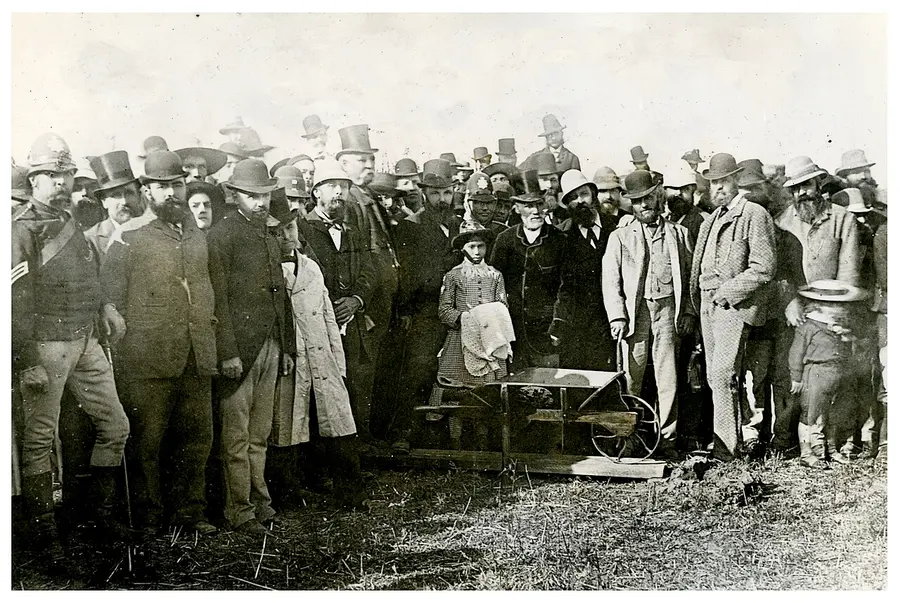
Prime Minister Joseph Ward drove the last spike at Manganuioteao, formally opening the railway between Auckland and Wellington.
A railway between Auckland and Wellington had been talked about since the 1860s, but in the 1870s rail-building efforts went elsewhere. By 1880 Auckland's southern line reached Te Awamutu, and there were isolated sections in Taranaki, Manawatū and Hawke's Bay and between Wellington and Wairarapa. Between them lay rugged mountains, dense forests and Te Rohe Pōtae (the King Country), where after the wars Ngāti Maniapoto had set up an aukati (a boundary keeping Europeans out). Surveys began in 1882, and in 1884 a parliamentary committee chose a central route. Between 1883 and 1885 the Crown and Ngāti Maniapoto negotiated Te Ōhākī Tapu, a series of agreements through which Ngāti Maniapoto sought Crown recognition of their authority over their lands and people, and in return lifted the aukati and allowed the railway through. The Ngāti Maniapoto leader Wahanui Huatare said Premier Robert Stout had promised that no hotel would be built in the district, no liquor sold and no land courts held.
On 15 April 1885 Stout, Wahanui and Rewi Maniapoto ceremonially turned the first sod of the central section by the Pūniu River near Te Awamutu. It would take 23 years to complete the 680-kilometre line. Progress was slow in the 1890s but quickened after 1900, and by 1904 the northern and southern sections had reached Taumarunui and Taihape. South of Taumarunui the steep climb onto the Waimarino plateau was solved by the civil engineer Robert Holmes, whose Raurimu Spiral used two tunnels, three horseshoe curves and a complete circle. Steel viaducts bridged deep ravines at Makatote, Hāpuawhenua, Mangaweka and Makōhine. In 1906 the workforce topped 2700, and in 1907 an extra shift was added, with men working through the night by kerosene lamps. They lived in isolated shanty towns; visiting Raurimu in the winter of 1908, the railways cadet G. G. Stewart found '[c]ontinuous heavy rain, with occasional hail, sleet and snow, much fog, miry clay'.
By May 1908 only a 24-kilometre gap remained, between the unfinished Makatote viaduct and Ohakune. The Public Works Department rushed through a temporary, unballasted link so that a 'Parliament Special' could carry Prime Minister Sir Joseph Ward and other MPs to Auckland to greet the United States Navy's visiting Great White Fleet. Leaving Wellington on the evening of 7 August, it was the first train to travel the length of the line, and the trip took 20½ hours. The line was formally opened on 6 November 1908, when Ward drove home a final polished silver spike at Manganuioteao, between Waimarino (National Park) and Ohakune. A reporter called the ceremony 'as impressive as scowling weather, muddy embankments and interfering photographers would permit'. Ward was presented with a sterling silver spike to mark the event, now held by Te Papa. Express trains from February 1909 made the journey in 18 hours, and from 1924 the Night Limited cut it to about 14 hours.
In Te Ara's assessment the line fostered economic and population growth in the North Island, opened Pākehā access to the Māori-dominated interior and sped up the destruction of the great forests. Until at least the Second World War almost everyone travelling between the capital and the biggest city took the train. For Ngāti Maniapoto the results were different. After the survey the Native Land Court began hearings in Te Rohe Pōtae, and from 1890 the Crown bought up individual interests in their land. In the Maniapoto Claims Settlement Act 2022 the Crown acknowledged that it 'derived enormous benefits' from Te Ōhākī Tapu but broke its promises, including to take only as much land as the railway needed, and that it paid no compensation for the section of line south of the Pukenui block. It apologised 'for failing to uphold Te Ōhākī Tapu'.
Make a poster of your own family’s story, alongside the history they lived through. Create your own poster
Regions affected
Sources
Written for this project from these references rather than copied from them. Follow a link to read the full account, or to check this one against the original.
Related
Vogel’s public works and immigration scheme
Julius Vogel borrowed heavily in London — £10 million by 1876 — to build railways, roads and telegraph lines, and to bring in about 100,000 assisted migrants.
New Zealand enters the First World War
About 100,000 served overseas from a population of just over a million. Around 18,000 died and there were some 41,000 instances of wounding or illness; no other British dominion lost a higher share of its military-age men.
New Zealand declares war on Germany
‘Where she goes, we go’ — 140,000 served overseas and nearly 12,000 died, from a population of 1.6 million.
Rogernomics — the economy is deregulated
A Labour government floated the dollar, removed farm subsidies and tariffs, and sold state assets in a radical programme of market liberalisation.