Ernest Rutherford wins the Nobel Prize
- When
- 10 December 1908
- Where
- Brightwater, Nelson · Brightwater
- Reach
- Nationwide
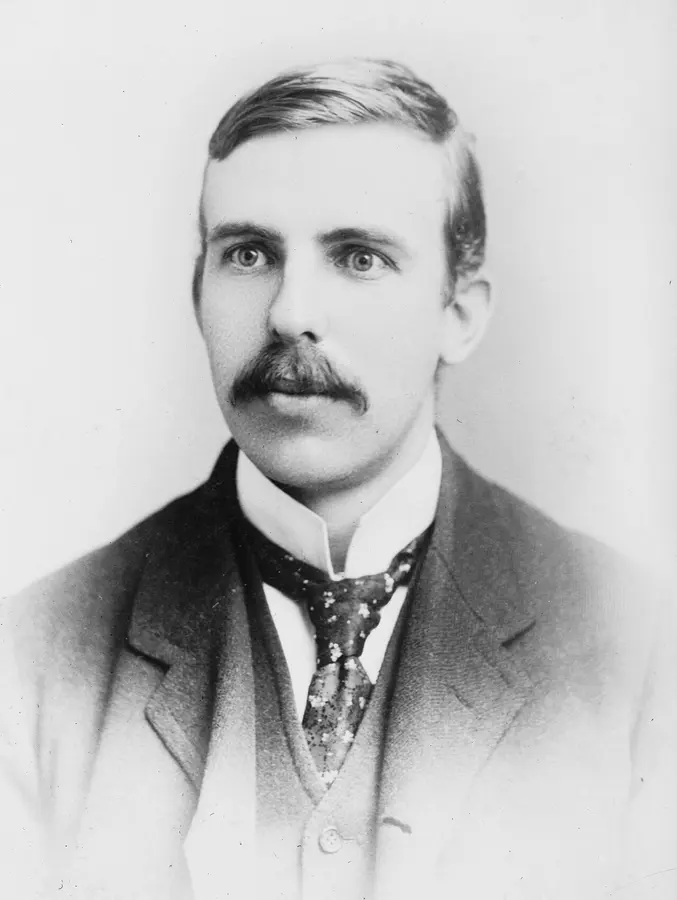
Born at Spring Grove near Brightwater and raised partly on a family farm, Ernest Rutherford won the Nobel Prize in Chemistry, then discovered the atomic nucleus and split the atom.
Ernest Rutherford was born at Spring Grove in rural Nelson, near Brightwater, on 30 August 1871, the fourth of 12 children of James Rutherford, a mechanic, and Martha Thompson, who had been the Spring Grove schoolteacher. When he was five the family moved to a small farm near Foxhill, and in 1883 to Havelock, at the head of the Marlborough Sounds, to be nearer the flax mill his father was operating. According to NZHistory, he later claimed that helping out on his parents' farm had honed his inventiveness: 'We haven't the money, so we've got to think.' He boarded at Nelson College from 1887 to 1889 and attended Canterbury College in Christchurch from 1890 to 1894, leaving with three degrees. In 1894 he reported his experiments on the magnetisation of iron by high-frequency discharges, and Te Ara counts this among the first physics articles in the journal of the New Zealand Institute.
Rutherford was awarded an 1851 Exhibition scholarship after the first nominee, James Maclaurin of Auckland University College, could not agree to its new conditions. He left New Zealand in 1895 to work under J. J. Thomson at the Cavendish Laboratory of the University of Cambridge, the first non-Cambridge graduate to become one of its research students. His interest soon turned to radioactivity, and in 1898 he found that radioactive atoms give off two separate types of emission, which he named alpha and beta rays. That year he became a professor at McGill University in Montreal, Canada. There, with the young chemist Frederick Soddy, he showed that some heavy atoms spontaneously decay into slightly lighter, chemically different atoms. Realising that lead was the final decay product of uranium, he proposed that the proportions of the two could be used to date minerals, and radioactive dating became an important part of modern geology. On 28 June 1900 he married Mary (May) Newton, the daughter of his Christchurch landlady.
In 1907 Rutherford moved to Victoria University of Manchester, and in 1908 he was awarded the Nobel Prize in Chemistry 'for his investigations into the disintegration of the elements, and the chemistry of radioactive substances'. NZHistory dates the award to 10 December 1908, and points out that Rutherford was a physicist although the prize was for chemistry. At Manchester he showed that the alpha particle was a helium atom stripped of its electrons, and with Hans Geiger developed a way of detecting single particles that evolved into the Geiger–Müller tube. In 1909 Geiger and a student, Ernest Marsden, fired alpha particles at a thin gold foil and found that some bounced back. Rutherford said it was 'almost as incredible as if you fired a 15-inch shell at a piece of tissue paper and it came back and hit you'. In 1911 he deduced from these results that almost all of an atom's mass is concentrated in a tiny nucleus. Niels Bohr, a young Dane who came to work with Rutherford, built on this, and the Rutherford–Bohr atom still features in school chemistry and physics books worldwide.
Rutherford was knighted in the 1914 New Year's honours. During the First World War he worked on acoustic methods of detecting submarines, and in 1916 said he hoped no way of releasing the energy of the atom would be found until man was 'living at peace with his neighbours'. Near the end of the war, while bombarding nitrogen atoms with alpha rays, he observed outgoing protons (the nuclei of hydrogen atoms) and deduced that the nitrogen atoms had been converted into another element, which made him the first person to split the atom. Te Ara's biography says he concluded the nitrogen had become hydrogen; NZHistory says oxygen. NZHistory dates the work to 1917 and its publication to 1919, the year Rutherford became director of the Cavendish Laboratory. On his last visit home, in 1925, he spoke to packed halls, and his support helped bring about the Department of Scientific and Industrial Research (DSIR) in 1926. In 1931 he was made Baron Rutherford of Nelson, with a kiwi and a Māori warrior on his coat of arms.
Rutherford died at Cambridge on 19 October 1937, after delays in operating on a hernia, and his ashes were interred in Westminster Abbey. Nuclear fission was discovered two years later. In 1969 element 104 was named rutherfordium, and NZHistory notes that he is the only New Zealander to have a chemical element named in his honour. His portrait has been on New Zealand's $100 banknote since 1992. In 1991 the Rutherford Origin, a garden with a permanent outdoor display about his life and work, was built on the site of his birth, and a memorial at Brightwater has a statue of him as a young boy. By 2018 three New Zealand scientists had received a Nobel Prize for science: Rutherford, Maurice Wilkins in 1962 and Alan MacDiarmid in 2000.
The defining moments of New Zealand, on one poster. Get your digital print for $25
Regions affected
Sources
Written for this project from these references rather than copied from them. Follow a link to read the full account, or to check this one against the original.
- Rutherford, Ernest
- Physics, chemistry and mathematics – Physical sciences, 1760s to 1890s
- Physics, chemistry and mathematics – New Zealand physicists overseas
- Awards and prizes – General and international awards
- Ernest Rutherford
- Rutherford wins Nobel Prize
- Ernest Rutherford stamp
- Ernest Rutherford memorial, Brightwater
Related
Edmund Hillary summits Everest
An Auckland beekeeper and Tenzing Norgay reached the summit of Everest, and the news was released in London on the morning of the Queen’s coronation.
AucklandThe 1953–54 royal tour
Elizabeth II became the first reigning monarch to visit New Zealand. Perhaps three in four New Zealanders saw her in person.
The Ngāi Tahu settlement
A grievance first formally stated in 1849 was finally settled: $170 million, an apology, and Aoraki/Mount Cook, vested in the iwi and gifted back to the nation, over land covering most of the South Island.
Ōnuku Marae, AkaroaTelevision broadcasting begins
AKTV2 went to air in Auckland for three hours on its first night, opening with The Adventures of Robin Hood. At first regular programmes went out only on Wednesday nights.
Auckland