Television broadcasting begins
- When
- 1 June 1960
- Where
- Auckland · Tāmaki Makaurau
- Reach
- Several regions
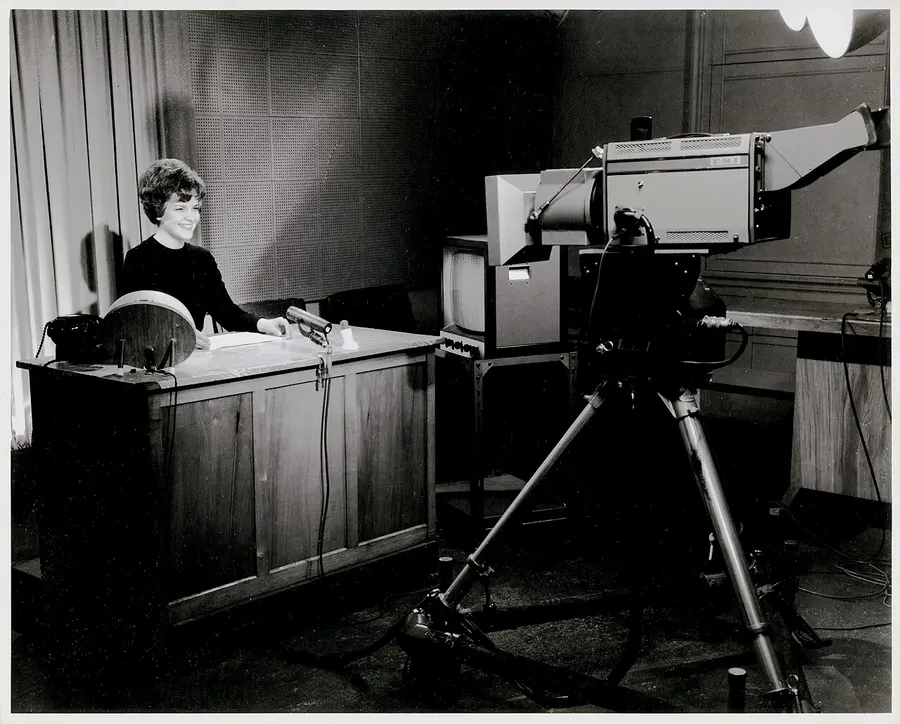
AKTV2 went to air in Auckland for three hours on its first night, opening with The Adventures of Robin Hood. At first regular programmes went out only on Wednesday nights.
Television was slow to arrive in New Zealand. Britain's BBC had started the world's first public service in 1936, NBC began broadcasting in the United States in 1939, and Australia had stations operating by 1956. In New Zealand a government committee began studying the new medium in 1949. In March 1951 the New Zealand Broadcasting Service (NZBS) gave closed-circuit demonstrations in its Auckland and Wellington studios, and each centre's demonstrations attracted around 3000 people. In 1957 the Auckland company Bell Radio-Television Corporation obtained an experimental licence, and the 1966 Encyclopaedia of New Zealand estimated that its early transmissions reached about 100 set-holders. By 1959 two channels were broadcasting experimental transmissions in Auckland, channel one run by Bell and channel two by the NZBS. In November 1959 Prime Minister Walter Nash suggested, on the BBC programme Press Conference, that television would be introduced within 12 months. On 28 January 1960 the government announced that the state would operate the service, introducing it gradually in the four main centres, with Auckland first.
On Wednesday 1 June 1960 the NZBS made the country's first regular, non-experimental television transmission on Channel 2, the Auckland station known as AKTV2. Broadcast from Shortland Street in central Auckland, it began at 7.30 p.m., lasted just three hours and could be seen only in Auckland. It included an episode of The adventures of Robin Hood, a live interview with a visiting British ballerina and a performance by the Howard Morrison Quartet. At first regular programmes went out only on Wednesday nights. From 11 July Monday nights were regular too, within a month programmes were screening on four nights a week, and by January 1961 they were on every night. On 6 July a news programme was included for the first time, made up at first entirely of film bought from the British Commonwealth International News Agency. Television licences, costing £4 a year, were introduced in August 1960.
Christchurch followed on 1 June 1961 and Wellington on 1 July 1961, but Dunedin had to wait until 31 July 1962. There was no national network, and each centre saw local programmes. Overseas programmes were flown from centre to centre and played in different cities in successive weeks. NZHistory dates the introduction of advertising to 1961, and Te Ara says it came within a year of the first official broadcast. Initially advertisements were allowed only on Tuesday, Wednesday, Thursday and Saturday, and more revenue came from licences than from advertising. On 1 April 1962 the stations came under the control of the new New Zealand Broadcasting Corporation (NZBC). By 1965 more than 300,000 licences had been issued, and the 1966 Encyclopaedia reported that in four years television had reached nearly half of New Zealand households.
Networking began on 3 November 1969, when all stations broadcast the NZBC network news. Te Ara notes that for the first time all New Zealanders could watch the same news at the same time. Satellite facilities opened at Warkworth in 1971, and NZHistory says the NZBC completed the national television network in 1973, the year colour broadcasting began.
In Trisha Dunleavy's account for Te Ara, New Zealand television's first era, from 1960 to 1989, was one of scarcity, in which a single publicly owned network defined television's culture, schedules and programming. That monopoly gave the state channels unrivalled influence, but it also left television subject to state control of its spending and operations. Television changed other media too. Te Ara's history of radio records that evening radio went into decline as people switched to television, and that radio had to adjust to no longer being New Zealand's principal broadcasting medium. Sport was televised from 1960 and became a dominant part of New Zealand television, with up to half the population watching important games. Writing half a century after the first broadcast, NZHistory described TV viewing as a familiar, shared daily ritual for most New Zealanders, young and old.
The defining moments of New Zealand, on one poster. Get your digital print for $25
Regions affected
Sources
Written for this project from these references rather than copied from them. Follow a link to read the full account, or to check this one against the original.
- Television in New Zealand
- Television – History of television in New Zealand
- Television – News and current affairs
- Radio – A turning point for radio: the legacy of the 1960s
- Television (1966 Encyclopaedia of New Zealand)
- Recent growth (1966 Encyclopaedia of New Zealand)
- New Zealand's first official TV broadcast
- Television in New Zealand – Introduction
- TV emerges in New Zealand timeline
- Early evening news on TV
Related
The 1953–54 royal tour
Elizabeth II became the first reigning monarch to visit New Zealand. Perhaps three in four New Zealanders saw her in person.
Decimal currency day
Pounds, shillings and pence became dollars and cents, promoted by a cartoon character called Mr Dollar.
The 1951 waterfront dispute
Lockout and strike ran for 151 days. Emergency regulations made it a crime even to give food to a watersider’s children.
Wellington waterfrontNew Zealand declares war on Germany
‘Where she goes, we go’ — 140,000 served overseas and nearly 12,000 died, from a population of 1.6 million.