The 28th (Māori) Battalion
Te Hokowhitu-a-Tū
- When
- 1940–1946
- Reach
- Nationwide
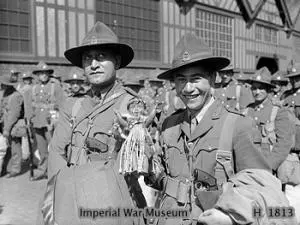
A volunteer battalion organised by tribal area fought in Greece, Crete, North Africa and Italy. Its casualty rate was almost 50% above the average for New Zealand infantry battalions.
Soon after war was declared in September 1939 (see New Zealand declares war on Germany), telegrams from Māori leaders offering men for home defence and overseas service reached Parliament, followed by requests for a Māori unit. Sir Apirana Ngata saw military service as 'the price of citizenship'. He argued that the Treaty of Waitangi gave Māori the rights of British subjects and with them a duty to help defend the Empire, and asked how Māori could hold up their heads after the war if they faced the question, 'Where were you when New Zealand was at war?' Other Māori disagreed. Some argued that casualties would be heavy and that a population NZHistory puts at not quite 90,000 and Te Ara at just under 100,000 could not keep an infantry battalion supplied with reinforcements; some of these preferred a pioneer (labour) unit like the one in the First World War. Others, remembering the wars of the 1860s, wanted Māori kept at home. Te Puea Hērangi held to Waikato's opposition to fighting overseas while the government ignored their land grievances, telling Peter Fraser in 1941, 'I'm not anti-Pākehā; I'm not pro-German; I'm pro-Māori.'
On 4 October 1939 the government announced that it would form the 28th (Māori) Battalion. It was organised on tribal lines. A Company came from North Auckland, Ngāpuhi and its subtribes; B Company from Rotorua, the Bay of Plenty, Taupō and Thames–Coromandel, mostly Te Arawa and Tūhoe; and C Company from the East Coast, including Ngāti Porou and Rongowhakaata. D Company drew on a much wider area, from Waikato–Maniapoto and Taranaki to Hawke's Bay, Wellington, the South Island, the Chatham Islands and Stewart Island. The first commander was George Dittmer, a Pākehā professional soldier. The men assembled at the Palmerston North showgrounds in January 1940, on the 28th according to NZHistory's timeline and on the 26th according to Wikipedia, and trained there for three months. Every man who served in it was a volunteer, and Māori remained exempt from conscription throughout the war. On 1 May 1940 about 780 men left the showgrounds for Wellington and sailed the next day on the Aquitania with 2NZEF's Second Echelon. Bound at first for Egypt, the echelon was diverted to Britain, and the battalion helped defend southern England for the rest of 1940.
In 1941 the battalion fought in Greece and then on Crete, where its men gained a reputation in close-quarters fighting. In North Africa it took part in the capture of Sollum and Gazala, the breakout at Minqar Qaim and the Battle of Alamein. At Tebaga Gap in Tunisia on 26 March 1943, Second Lieutenant Te Moananui-a-Kiwa Ngārimu of Ngāti Porou led his platoon up a hill that his men called Hikurangi, after their mountain at home. Although wounded, he held it through the night, at one point throwing stones when grenades ran out, and was killed by a counter-attack the next morning. He became the first Māori to win the Victoria Cross while serving with New Zealand forces, and the medal was presented to his parents at Ruatōria on 6 October 1943 before 7000 Māori. In April 1943 Sergeant Haane Manahi of Te Arawa led the capture of the Takrouna pinnacle and was recommended for the Victoria Cross, but received the lesser Distinguished Conduct Medal instead, for reasons that remain unknown.
In Italy the battalion attacked Orsogna in December 1943 and, on 17 February 1944, captured the railway station at Cassino, but a German counter-attack forced it to withdraw the next day. Of the 200 men in the two attacking companies, 128 were killed, wounded or captured. It then took part in the advance on Florence, fought around Faenza and joined the final race to Trieste. Apart from 270 men sent to serve in Japan, the battalion returned to New Zealand in January 1946. More than 3600 men served in it: 649 were killed or died on active service, 1712 were wounded and 267 were taken prisoner or went missing. Its casualty rate was almost 50% higher than the average for New Zealand infantry battalions. It received 99 honours and awards, the most of any New Zealand infantry battalion and 70% above their average.
Altogether, close to 16,000 Māori enlisted during the war, according to NZHistory; Te Ara gives 15,744 volunteers. At home the Māori War Effort Organisation, set up on 3 June 1942, helped with recruiting and food production (see Māori War Effort Organisation), and work in city factories began a movement to the cities that grew after the war (see The great Māori urban migration). Ngata wrote that Māori would lose some of their most promising young leaders but would 'gain the respect of our Pakeha brothers'. His son Henare, an officer in the battalion, wrote that he doubted Māori could point to any specific benefit from their men's part in the war. NZHistory concludes that after the war it was clear that Māori 'had paid in full'. The Ngārimu VC and 28th (Māori) Battalion Memorial Scholarship Fund was set up in 1945 to promote Māori education and the Māori language and culture, and in March 2007 Prince Andrew presented Manahi's iwi, Te Arawa, with an altar cloth, a ceremonial sword and a letter from the Queen to honour him.
The defining moments of New Zealand, on one poster. Get your digital print for $25
Regions affected
Sources
Written for this project from these references rather than copied from them. Follow a link to read the full account, or to check this one against the original.
- Māori and the Second World War
- Māori and the Second World War – Response to war
- Māori and the Second World War – Achievements
- Māori and the Second World War – The home front
- Māori and the Second World War – Impact
- Second World War overview – Second World War timeline
- The Second World War at home – War work
- The Second World War at home – It's war again
- Ngā pakanga ki tāwāhi – Māori and overseas wars – Second World War: the Māori war effort
- Ngā pakanga ki tāwāhi – Māori and overseas wars – The 28th (Māori) Battalion
- Ngārimu, Te Moananui-a-Kiwa
- Second World War – North African campaign
- Māori Battalion
Related
The Native Land Court is established
The court converted customary communal title into individual titles that could be sold, and became the main means by which most remaining Māori land passed out of Māori ownership.
New Zealand declares war on Germany
‘Where she goes, we go’ — 140,000 served overseas and nearly 12,000 died, from a population of 1.6 million.
New Zealand enters the First World War
About 100,000 served overseas from a population of just over a million. Around 18,000 died and there were some 41,000 instances of wounding or illness; no other British dominion lost a higher share of its military-age men.
Māori War Effort Organisation
Over 300 tribal committees took on Māori recruiting, war work and local food production; Māori felt that for the first time they bore real responsibility for their own affairs.