A frigate sails to Mururoa
- When
- 28 June 1973
- Where
- Devonport Naval Base · Tāmaki Makaurau
- Reach
- Nationwide
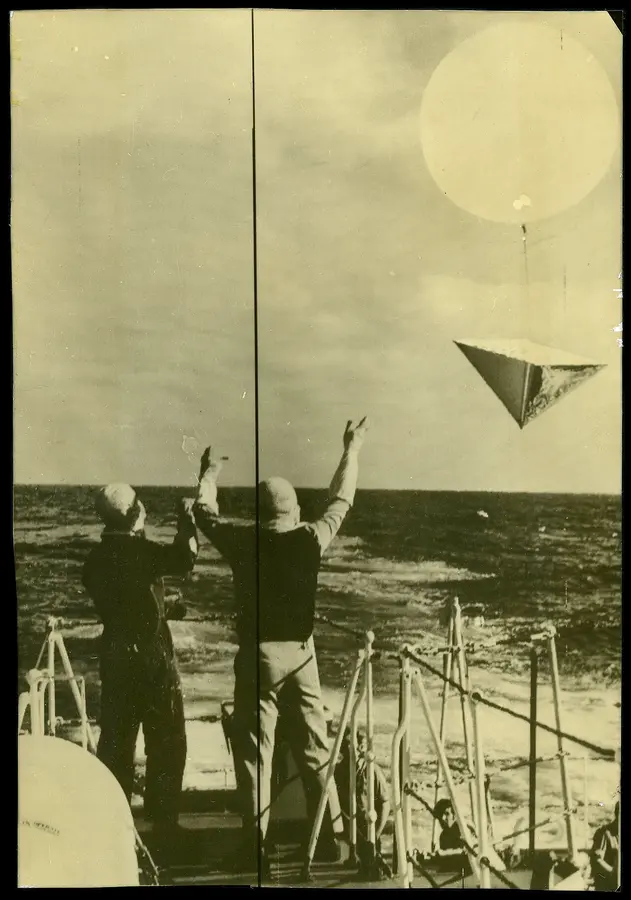
Norman Kirk sent HMNZS Otago, with a cabinet minister aboard, to sit off the French nuclear test zone in protest.
When New Zealand and Australia aligned themselves with the United States through the ANZUS agreement in 1951, they effectively accepted the protection of what some described as the nuclear umbrella. In the 1950s New Zealand military personnel observed British and American nuclear tests, and Royal New Zealand Navy vessels served as weather ships for British tests in the Indian Ocean. In 1963 the British, American and Soviet governments agreed to ban atmospheric tests. New Zealand signed the treaty, but France did not. From 1966 France conducted atmospheric nuclear tests at Mururoa (or Moruroa), an atoll 1250 kilometres south-east of Tahiti, having shifted its testing from the Sahara to the Pacific. New Zealanders protested against the tests from the mid-1960s, and in 1972 Greenpeace vessels sailed into the test site, delaying tests by several weeks. On 25 November 1972 Labour, led by Norman Kirk, won the general election with a majority of 23 seats. Kirk said his government wanted New Zealand's foreign policy 'to express New Zealand's national ideals as well as reflect our national interests'.
In May 1973 the New Zealand and Australian governments took France to the International Court of Justice in an attempt to ban the tests. The court issued an interim ruling that France must cease testing, which NZHistory dates to 23 June 1973, but France ignored it. Kirk's government responded by deciding to station two frigates, HMNZS Otago and HMNZS Canterbury, in turn in international waters outside the test area, with a Cabinet minister on board. Kirk's biographer Michael Bassett records that the aim was 'to provide a focus for international opinion against the tests'. Kirk put all his ministers' names into a hat and drew out that of Fraser Colman, the minister of immigration and mines. Some insiders, NZHistory records, unkindly suggested that the lowly ranked Colman's name had been written on every slip of paper. The opposition National Party declined an invitation to send a representative. Its leader, Jack Marshall, called the despatch of the frigate 'irresponsible', a 'futile and empty gesture' that would only inflame the situation, and preferred to hold France to account through the court.
Kirk told the 242 crew of Otago that their mission was an 'honourable' one: they were to be a 'silent accusing witness with the power to bring alive the conscience of the world'. Otago sailed from Auckland on 28 June 1973 with Colman aboard. A month later those on board witnessed the first atmospheric test; Wikipedia identifies it as the test code-named 'Euterpe', carried out on 28 July. When Canterbury arrived to relieve Otago, Colman transferred to it, and he and Canterbury's crew saw a second French atmospheric test at Mururoa. France carried on testing in the atmosphere regardless.
NZHistory judges that the protests had some success. In 1974, by which time 41 atmospheric tests had been conducted at Mururoa, the new French president, Valéry Giscard d'Estaing, decided that future testing would be held underground. NZHistory also credits mounting international pressure for the switch. Testing went on until 1996, and the atoll remained a focus of anti-nuclear protest; the test site was dismantled after France's last underground explosion that year. From the early 1970s to the mid-1980s, NZHistory notes, two key issues emerged in New Zealand's anti-nuclear politics: opposition to French tests at Mururoa and to visits by American warships. Animosity towards France intensified in 1985, when French agents sank the Greenpeace boat Rainbow Warrior in Auckland, killing one crew member. In 1987 Labour passed the New Zealand Nuclear Free Zone, Disarmament, and Arms Control Act, and by 1990 even National had signed up to anti-nuclearism.
In Peter Aimer's account on Te Ara, Labour at first seemed to respond to the excitement of the times: besides sending the frigate, it ended New Zealand's involvement in the Vietnam War and ended conscription at home. In Bassett's reading, Kirk was heading an activist government the like of which had not been seen in New Zealand for 40 years. Te Ara's history of the French in New Zealand describes the frigate as having been sent into the Pacific as a silent witness, echoing Kirk's own words to the crew.
The defining moments of New Zealand, on one poster. Get your digital print for $25
Regions affected
Sources
Written for this project from these references rather than copied from them. Follow a link to read the full account, or to check this one against the original.
- Nuclear-free New Zealand
- Nuclear testing in the Pacific — Nuclear-free New Zealand
- Nuclear-free legislation — Nuclear-free New Zealand
- HMNZS Otago sails for Mururoa test zone
- World Court condemns French nuclear tests
- 1973 – key events
- Kirk, Norman Eric
- Labour Party – Second and third Labour governments
- French – People and culture
- HMNZS Otago (F111)
Related
Western Samoa becomes independent
The first Pacific nation to regain independence in the twentieth century did so from New Zealand, ending more than 47 years of often harsh administration.
New Zealand becomes nuclear free
Legislation barred nuclear-armed and nuclear-powered ships from New Zealand’s internal waters. The US had already withdrawn its ANZUS security guarantee.
WellingtonNew Zealand votes for MMP
By 54 to 46 percent, voters replaced first-past-the-post with mixed-member proportional representation, after decades of falling trust in politicians.
The first MMP election
The first proportional Parliament took two months of negotiation to produce a government, and looked more like the country than any before it.