Battle of Rangiriri
- When
- 20 November 1863 – 21 November 1863
- Where
- Rangiriri
- Reach
- Local
Kīngitanga defenders held the central redoubt against repeated assaults; next morning a white flag raised to ask for terms was treated as surrender.
After the Meremere line was outflanked (see Invasion of the Waikato), the Kīngitanga made its next stand at Rangiriri, on a ridge between the Waikato River and Lake Waikare. The works were an entrenched parapet with ditches on both sides and concealed rifle pits, and the obvious approach from the north was covered by a central redoubt designed by Pene Te Wharepū, a Ngāti Hine rangatira (chief) from Taupiri. Lieutenant-General Duncan Cameron later conceded that the British had not detected how strong it was. But the earthworks were incomplete, and the pā was seriously undermanned: fighters had been rotating home for nearly three months, and many had left to plant crops. Te Ara puts the garrison at about 500. A number of important leaders, probably including King Tāwhiao and Wiremu Tāmihana, were there.
On 20 November 1863 Cameron assembled about 860 men with artillery north of the pā, while another 600 were ferried upstream by the river fleet to land behind it. After a two-hour bombardment he ordered a frontal assault. The forward rifle pits were quickly overrun, and the river force occupied the abandoned rear defences, but the central redoubt, 'barely 12 paces' wide and crowded with defenders, including women who reloaded muskets, held firm. Te Ara describes the first assault and three more being repulsed; the historian James Belich, Cameron's biographer, counts eight. Even the artillerymen and a naval party were sent in. Captain Henry Mercer of the Royal Artillery was shot in the face, and Assistant Surgeon William Temple and Lieutenant Arthur Pickard later received the Victoria Cross for helping the wounded under fire. By nightfall the redoubt was still untaken. Overnight some defenders escaped by the eastern ditch to Lake Waikare, among them Tāmihana and, perhaps, Tāwhiao with the wounded, including the mortally wounded Te Wharepū.
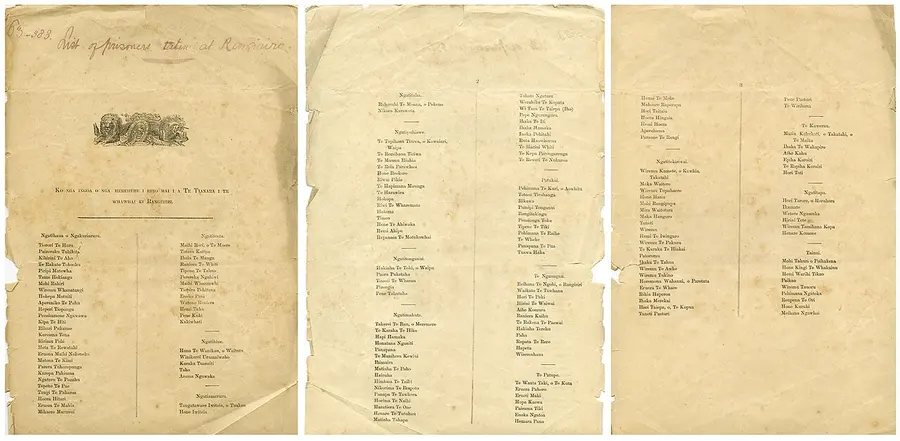
At dawn the remaining defenders raised a white flag. In an account recorded by Archdeacon Robert Maunsell, Lieutenant George Pennefather said his men scrambled into the redoubt and shook hands; Cameron demanded their arms, and the chiefs, though they said they had raised the flag to ask what terms they might expect, decided resistance was out of the question. NZHistory says the British 'chose to interpret' the flag as surrender; Te Ara says officers found that Māori 'actually wished to negotiate a truce'. In his Dictionary of New Zealand Biography entry on Cameron, Belich writes that Cameron took the pā by 'unscrupulously manipulating a flag of truce'. Counts of prisoners differ: NZHistory gives 183, Te Ara 'nearly 200', and Belich 180.
Casualty figures also differ. NZHistory gives 35 British and a similar number of Māori killed, with ten more British dying later of wounds; Te Ara says about 40 on each side lost their lives. The prisoners were held on a hulk in Waitematā Harbour and then on Kawau Island in the Hauraki Gulf, from which they escaped to the mainland in September 1864. Cameron was knighted for the victory, and after he occupied Ngāruawāhia on 8 December, Grey told London that 'the neck of this unhappy rebellion is now broken'. But Tāwhiao had already withdrawn into Ngāti Maniapoto territory. For decades State Highway 1 ran through the site. In the 2010s the government returned much of it to the Kīngitanga, the road was moved away when the Waikato Expressway was built, and Ngāti Naho set out to reconstruct trenches near the pā; thousands of school students, tourists and local people have visited the site.
The defining moments of New Zealand, on one poster. Get your digital print for $25
Regions affected
Sources
Written for this project from these references rather than copied from them. Follow a link to read the full account, or to check this one against the original.
Related
Invasion of the Waikato
Te riri ki Waikato
British and colonial troops crossed the Mangatāwhiri to break the Kīngitanga — the key conflict of the New Zealand Wars, with 12,000 imperial and 4,000 colonial troops eventually available.
MangatāwhiriBattle of Ōrākau
About 300 defenders held an unfinished pā against more than 1,400 troops for three days, then broke out through the British lines in daylight.
ŌrākauThe ambush at Ōpepe
A detachment of Bay of Plenty Cavalry was surprised in camp at Ōpepe, near Taupō, by Te Kooti’s advance guard. Nine of the fourteen troopers were killed and their arms and horses taken.
ŌpepeThe battle of Te Pōrere
NZHistory calls it the last major battle of the New Zealand Wars, fought at a British-style redoubt below Tongariro. Te Kooti lost thirty-seven men and escaped wounded.
Te Pōrere