The burning of the Boyd
- When
- December 1809
- Where
- Whangaroa Harbour · Whangaroa
- Reach
- Local
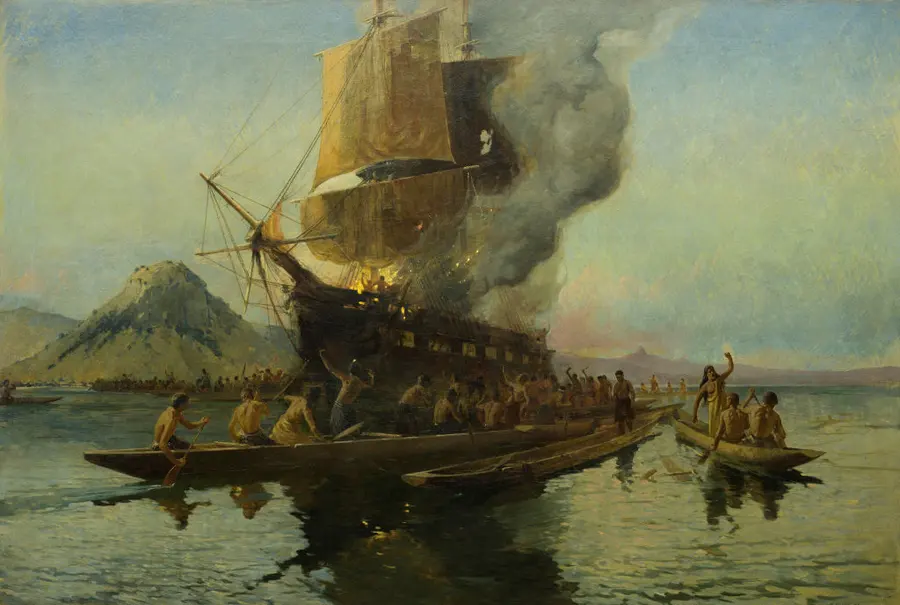
Between 66 and 70 crew and passengers were killed and the ship burned at Whangaroa, after the flogging of a rangatira’s son aboard. For some years afterwards few ships came to New Zealand.
The Boyd, a brigantine of 395 tons, had been used to transport convicts to New South Wales. It sailed from Port Jackson (Sydney) in October 1809 under Captain John Thompson, with about 70 people aboard, to pick up kauri spars at Whangaroa, on Northland's east coast. Among them was Te Ara, a Whangaroa chief's son whom the crew called George. He was coming home after more than a year on European ships, one of them a sealer. Few ships had called at Whangaroa; the Boyd was probably the third. Twelve months before, sailors from the Commerce had brought a sickness that killed several local Māori, and Ngāti Uru believed a curse had been laid on them. They met the next ship with suspicion.
Te Ara was supposed to pay for his voyage by working as a seaman. Accounts differ on what went wrong. He may have refused orders through illness, or because he thought the work beneath a chief's son. Another version says the cook blamed him for spoons the cook had lost overboard. Whatever the cause, Thompson stopped his food and had him tied up and whipped. Under British law, flogging was a common punishment for minor offences. In Te Ara's world a chief's son did not submit to an outsider, and the beating cost his father mana, or standing. When Te Ara reached home and showed his back, his kin resolved on utu (revenge). Asked later why they had attacked, some of those involved said simply that the captain was a 'bad man'.
On the third day Thompson, the chief officer and three crewmen went with Māori to look at kauri up the harbour, and once out of sight of the ship they were killed. At dusk a party wearing the dead men's clothes came back in the ship's boat while canoes waited, and most of those on board were killed that night. Bodies were eaten. A few people hid in the rigging. Next morning Te Pahi, a Rangihoua chief of the Bay of Islands, arrived by canoe and took them down. In the account Marsden later gave, the killers were local Māori who had come after him in their own canoes. Four survived: Ann Morley and her baby, two-year-old Betsey Broughton, and the cabin boy Thomas Davis, spared because he had looked after Te Ara following the flogging. The ship was grounded near Motu Wai (Red Island) and plundered. A musket flint set off the gunpowder, killing several Māori, Te Ara's father among them, and the Boyd burned to the waterline. Alexander Berry of the whaler City of Edinburgh later recovered the survivors.
From what informants told him, Berry decided that Te Pahi had been behind the attack. The whalers agreed, encouraged by Tara, chief at the rival anchorage of Kororāreka. On 26 March 1810 crews from five whaling ships stormed Te Pahi's island pā (fortified village) of Te Puna and destroyed his houses. Te Pahi's biographer puts the dead at about 60; other accounts give as few as 16. Te Pahi escaped wounded, then died within weeks of a wound taken when his people fought Whangaroa over the affair. In 1814 Marsden, on the word of Ruatara and Hongi Hika, concluded that the whalers had mistaken Te Pahi for Te Puhi of Ngāti Uru, Te Ara's brother, though Berry held that Te Pahi had been there from the start. His part remains unclear. The killings set the first mission back to 1814, few ships came to New Zealand for some years, and in Europe the country became the 'Cannibal Isles'.
The defining moments of New Zealand, on one poster. Get your digital print for $25
Regions affected
Sources
Written for this project from these references rather than copied from them. Follow a link to read the full account, or to check this one against the original.
Related
The Musket Wars
Musket-armed war parties reshaped the map of Māori New Zealand. Perhaps 20,000 died and whole districts changed hands before the fighting burned out around 1840.
The Northern War
Ngā Pakanga i te Tai Tokerau
Hōne Heke and his supporters felled the British flagstaff at Kororāreka four times, the last during the attack in which he and Kawiti sacked the town. Ngāpuhi fought on both sides. The war ended at Ruapekapeka, an engineered pā built to absorb artillery.
Kororāreka and RuapekapekaTe Rauparaha’s migration to Kapiti
Ngāti Toa left Kāwhia and migrated south, seizing Kapiti Island as a base that controlled Cook Strait and the trade passing through it.
Kapiti IslandThe Elizabeth affair
A British captain hid Te Rauparaha’s war party aboard his brig to capture the Ngāi Tahu chief Te Maiharanui — an affair that strengthened calls for an official British presence.
Akaroa Harbour