Samuel Marsden’s first Christian service
- When
- 25 December 1814
- Where
- Oihi Bay, Rangihoua · Rangihoua
- Reach
- Local
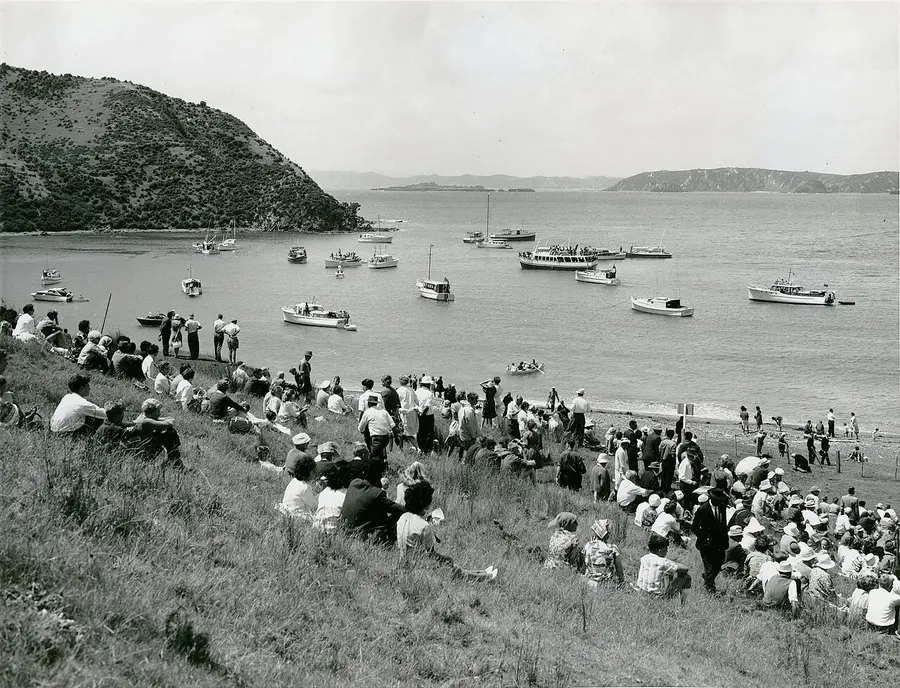
Marsden preached at Oihi Bay on Christmas Day 1814 under the protection of Ruatara, beginning the first permanent mission station in New Zealand.
Samuel Marsden, a Yorkshire-born Anglican clergyman, had served as a chaplain in New South Wales since 1794. He often housed visiting Māori at his home in Parramatta and taught them at his own cost; Te Pahi of Rangihoua visited in 1805. In 1807 he went to London to win the Church Missionary Society (CMS) over to a New Zealand mission, to be started by lay tradesmen rather than clergy: William Hall, a joiner, John King, a ropemaker, and Thomas Kendall, a schoolmaster. Sailing back in 1809 on the convict ship Ann, he found the young Ngāpuhi chief Ruatara aboard, ill and neglected after years of hard treatment on whaling ships. Ruatara had reached England hoping to see George III but had not been allowed ashore. He spent eight months with Marsden, studying farming and carpentry, and formed a plan to grow wheat at home.
Both plans stalled. After the Boyd was attacked at Whangaroa in 1809, the Colonial Office barred any settlement in New Zealand for a time. Ruatara was cheated again on his way home and left on Norfolk Island, and reached Rangihoua only around 1812. Te Pahi had died by then, and Ruatara was recognised as his successor. His wheat met disbelief until 1814, when a hand-powered flour mill from Marsden showed his fellow chiefs what the crop was worth. That year Marsden paid £1,400, mostly his own money, for a ship, the Active, and sent Kendall and Hall to the Bay of Islands to talk about a mission. They came back to Sydney with Ruatara and Hongi Hika. Governor Lachlan Macquarie, keen to help the mission, presented Ruatara with livestock, including a mare and a cow, and a military uniform.
The Active sailed into the Bay of Islands that December with Marsden, the three lay missionaries and their families. Stopping at Matauri Bay on 20 December, Marsden brought Ngāti Uru and Ngāpuhi to a peace. Two days later the party landed at Rangihoua, and a site for the station was chosen the next day. Ruatara built an enclosure on the shore for a Christmas service. On 25 December, at Oihi (Hohi), a small cove of Rangihoua Bay, Marsden opened with Psalm 100, the Old Hundredth, then preached on Luke 2:10, 'behold, I bring you good tidings of great joy'. Most of the large crowd were Māori, and Ruatara translated. Marsden spent the next weeks travelling with Ruatara and Hongi, loading flax and timber, and on 24 February 1815 he bought about 200 acres at Rangihoua for the mission before leaving for Sydney.
The mission stood on Ruatara's terms. In Sydney he had been warned that missionaries were only the vanguard of settlers and soldiers, and he never fully trusted them. By insisting they live at Rangihoua, where he could protect them, he also kept them under his control. He fell ill in February 1815 and died in early March, soon after Marsden sailed, and Hongi Hika carried on as the mission's protector. The sermon made little impression. Chiefs listened politely and let children attend school but had small reason to take up a faith that seemed to threaten their mana, and there were no Māori baptisms before 1830. The missionaries relied on Māori goodwill for food and safety. Kendall opened a school at Rangihoua in 1816 and worked at writing Māori down, which became one of the mission's lasting legacies.
The defining moments of New Zealand, on one poster. Get your digital print for $25
Regions affected
Sources
Written for this project from these references rather than copied from them. Follow a link to read the full account, or to check this one against the original.
Related
Bishop Pompallier founds the Catholic mission
Jean Baptiste Pompallier landed at Hokianga, breaking the Protestant monopoly on missionary work and adding a French presence that unsettled the British.
Tōtara Point, HokiangaTohunga Suppression Act
An Act making it an offence to practise as a tohunga, aimed at healers who claimed supernatural powers and at prophets such as Rua Kēnana.
The Rātana movement rises
Te Hāhi Rātana
Tahupōtiki Wiremu Rātana built a church and then a political movement that campaigned for the Treaty of Waitangi to be honoured.
Rātana PāThe Musket Wars
Musket-armed war parties reshaped the map of Māori New Zealand. Perhaps 20,000 died and whole districts changed hands before the fighting burned out around 1840.