The Rātana movement rises
Te Hāhi Rātana
- When
- 1920–1935
- Where
- Rātana Pā · Rātana
- Reach
- Several regions
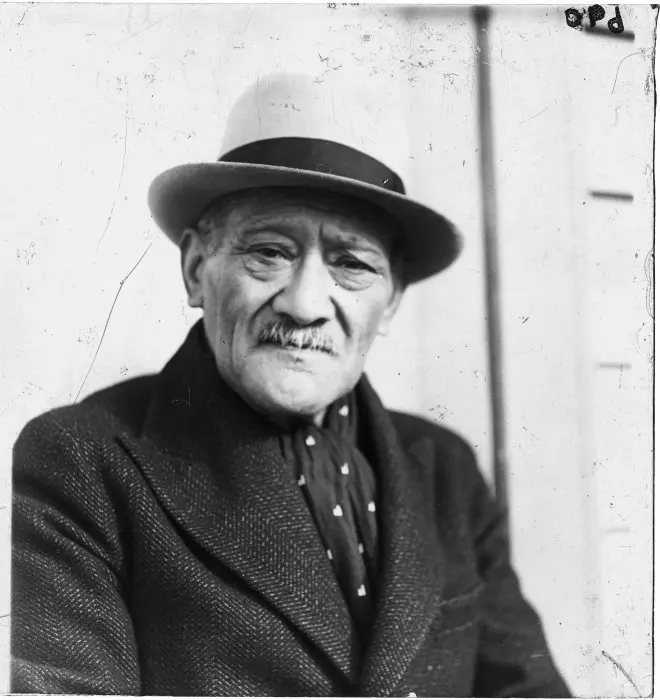
Tahupōtiki Wiremu Rātana built a church and then a political movement that campaigned for the Treaty of Waitangi to be honoured.
Tahupōtiki Wiremu Rātana was born on 25 January 1873 at Te Kawau, near Bulls. His family had connections with several iwi (tribes), but in official documents they usually described themselves as Ngāti Apa. His senior kinswoman Mere Rikiriki, a faith healer who had been at Parihaka with Te Whiti and Tohu (see The invasion of Parihaka), taught him her beliefs and skills. As a young man Rātana worked on the family farm, enjoyed rugby and racing, and was a champion ploughman and wheat stacker. On 8 November 1918, as the influenza epidemic spread through the country (see The influenza pandemic), he saw a strange cloud like a whirlwind approach and experienced a vision. Through him, his family heard the Holy Spirit say: 'wash yourselves clean, make yourselves ready.' From then on he was regarded as the Māngai (mouthpiece) of the Holy Spirit. He said his visions urged him to unite Māori under Ihoa o ngā Mano (Jehovah of the thousands), heal the people, and turn them from fear of tohunga (traditional experts) and the old atua (gods).
The first healing was of his son Ōmeka, who had a needle lodged behind his knee; after a week of intensive prayer the needle emerged from his thigh. Word spread. During 1919 and 1920 the train brought between 20 and 100 visitors a day to Rātana station, and a makeshift village grew on the family farm south-east of Whanganui, later named Rātana Pā. Te Ara says the settlement attracted the largest pan-tribal gathering of Māori for many decades. In 1921 and 1922 he toured the North and South Islands with dozens of supporters, and some meetings were attended by thousands. In some places more than half the Māori population agreed to become mōrehu (survivors), the name for his followers. He also had critics: some eyewitnesses said they had seen no cures, and Rēweti Kōhere campaigned against him in Māori newspapers.
In a speech at Christmas 1923 Rātana said he would take both the Bible and the Treaty of Waitangi on a journey to Britain, symbols of the spiritual and political sides of his mission. A party of 38 left Rātana Pā on 9 April 1924, hoping to present King George V with a petition on the Treaty and land confiscations. Te Ara says it was signed by 45,000 Māori; NZHistory says more than 30,000. The New Zealand government feared embarrassment and opposed any official presentation, and the party was prevented from even meeting the King. Pita Moko led a group to Geneva but failed to present the petition to the League of Nations. The party did get the petition into the hands of the New Zealand government, and NZHistory says Rātana's actions helped persuade the government in 1926 to set up a commission of inquiry into land confiscation, the Sim Commission. Back home, on 31 May 1925 Rātana announced that he would establish a separate church, Te Haahi Rātana; NZHistory dates its establishment to 21 July 1925, when the Registrar-General accepted the church's constitution. The temple, Te Temepara Tapu o Ihoa, was opened on 25 January 1928, Rātana's 55th birthday, and Rātana declared his spiritual mission complete.
From 1928 Rātana turned to politics. He called the four Māori seats in Parliament the four quarters of his body and aimed to win them all. He chose the candidates and asked them to sign a covenant pledging to work for the whole Māori race. In the 1928 election the initial result for Southern Māori was 198 votes each for Eruera Tirikātene and Tūiti Makitānara, and the returning officer gave his casting vote to Makitānara. Tirikātene won the seat at a by-election in 1932, becoming the first Rātana MP, with instructions to support Labour. Rātana's son Haami Tokouru won Western Māori in 1935. In 1936 Rātana declared himself and his family Labour Party members, and on 22 April that year he presented the prime minister, Michael Joseph Savage, with symbolic gifts. They included huia feathers, a potato, a piece of pounamu (greenstone) representing Māori mana, a broken watch representing broken Crown promises, and a Rātana pin.
Rātana members held three of the four Māori seats by 1938, and the fourth was won in 1943. The alliance held all four seats for Labour until 1993; in 1996 New Zealand First captured all the Māori electorates. Rātana died at Rātana Pā on 18 September 1939, and his tangihanga (funeral) lasted a week. His biographer, Angela Ballara, writes that he founded a national Māori church that melded the political and the spiritual in a way aimed for but not previously achieved by any other Māori leader, while to his Māori opponents and many Pākehā he was a charlatan and an over-ambitious politician. In 2018 the church had more than 40,000 members, making it the largest Māori denomination in New Zealand. Each January thousands gather at Rātana Pā to celebrate Rātana's birthday, and politicians come to be welcomed and speak on the marae at an event that signals the beginning of the political year.
The defining moments of New Zealand, on one poster. Get your digital print for $25
Regions affected
Sources
Written for this project from these references rather than copied from them. Follow a link to read the full account, or to check this one against the original.
Related
Tohunga Suppression Act
An Act making it an offence to practise as a tohunga, aimed at healers who claimed supernatural powers and at prophets such as Rua Kēnana.
The great Māori urban migration
Māori went from 26 percent urban in 1945 to nearly 80 percent by 1986 — a migration Te Ara says has been described as the most rapid movement of any population.
The 28th (Māori) Battalion
Te Hokowhitu-a-Tū
A volunteer battalion organised by tribal area fought in Greece, Crete, North Africa and Italy. Its casualty rate was almost 50% above the average for New Zealand infantry battalions.
The Native Land Court is established
The court converted customary communal title into individual titles that could be sold, and became the main means by which most remaining Māori land passed out of Māori ownership.