New Zealand Constitution Act
- When
- 30 June 1852
- Reach
- Nationwide
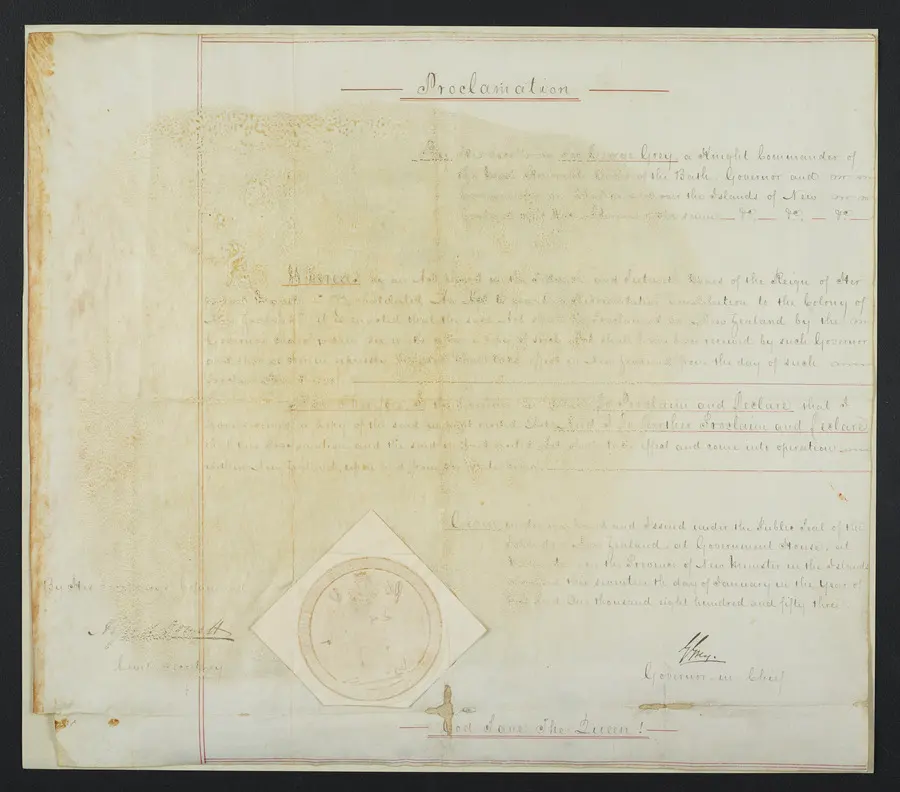
Representative government arrived, divided into six provinces — and the property franchise excluded almost all Māori, who held land communally.
For its first years as a British colony New Zealand was run by its governor. He was advised by an Executive Council of senior officials, and laws were made by a small Legislative Council of those officials plus three justices of the peace he chose himself. In 1846 the Colonial Secretary, Earl Grey, sent out a constitution that would have given settlers elected municipal, provincial and national bodies, and allowed for 'aboriginal districts' run by Māori custom. The governor, George Grey (no relation), refused to put it into effect. He was governing a colonial population of little more than 13,000 among some 100,000 Māori, and argued that the scheme would give a minority of one race power over a majority of another, which Māori were unlikely to accept peacefully. The 1846 constitution was suspended in 1848, and Grey went on governing with appointed councils, splitting the colony into two provinces, New Ulster and New Munster.
In the meantime Grey bombarded the Colonial Office with proposals of his own. He wanted a provincial system to suit the scattered settlements, a vote for everyone with a 'stake in the Colony', meaning property owners and householders, and that vote open to Māori who qualified, since he expected the 'two races' to fuse into 'one nation'. Settler leaders wanted more. In 1851 the lawyer Henry Sewell, acting for backers of the Canterbury settlement, drafted a plan to turn the Legislative Council into an elected assembly that would write its own constitution, but the Colonial Office found it too radical. Instead the British Parliament wrote most of Grey's ideas into the New Zealand Constitution Act, and his biographer calls him its chief author. The Act received royal assent on 30 June 1852, and Grey proclaimed it in force on 17 January 1853.
The Act divided the country into six provinces: Auckland, New Plymouth, Wellington, Nelson, Canterbury and Otago, with room to add more. Each had an elected superintendent and a provincial council of at least nine members, which handled matters such as public works and immigration. Over them sat a General Assembly made up of the governor, an appointed Legislative Council of at least ten members, and a House of Representatives of 24 to 42 members, elected every five years. The Assembly kept courts, customs, Crown land, marriage and similar matters, and could override provincial laws. Provinces could not legislate on land still held under Māori title, or impose any restriction on Māori that did not also apply to people of European descent. The governor could disallow legislation 'repugnant' to British law and kept control of the purchase of Māori land. The vote went to men aged 21 or over with freehold land worth £50, a lease worth £10 a year, or a house rented for £10 a year in town or £5 in the country. By British standards that was modest, and most male settlers qualified.
There was no racial bar in the franchise, and around 100 Māori, mostly tribal leaders who owned houses in or near European settlements, registered and voted in the first elections in 1853. But Māori land was owned collectively, not by individuals, and a court ruled that communal ownership did not carry the vote, so in practice Māori were shut out of a system meant to govern them. The Act did offer another route. Section 71 allowed the Crown to set aside districts where Māori laws and customs would be kept. Māori saw it as a way to give effect to the tino rangatiratanga (full chiefly authority) promised in the Treaty of Waitangi, and the Kīngitanga and later the Kotahitanga parliament movement both sought that kind of autonomy. No government ever used it, and it was finally repealed in 1986. Māori gained four seats of their own in 1867. The provinces were abolished in 1876, and the Act itself stayed part of the constitution until the Constitution Act 1986 repealed it.
The defining moments of New Zealand, on one poster. Get your digital print for $25
Regions affected
Sources
Written for this project from these references rather than copied from them. Follow a link to read the full account, or to check this one against the original.
- New Zealand Constitution Act comes into force
- Self-government and independence – Crown colony
- Self-government and independence – New Zealand Constitution Act 1852
- Constitution Act 1852 (Ngā take Māori – government policy and Māori)
- The 1852 Constitution and Responsible Government (1966 Encyclopaedia)
- Grey, George (Dictionary of New Zealand Biography)
- Sewell, Henry (Dictionary of New Zealand Biography)
- Māori and the vote
- Voting rights – First voting rights, 1852
- Self-government and independence – Towards a republic?
- The Provincial Period, 1853–76 (1966 Encyclopaedia)
- New Zealand Constitution Act 1852
Related
The provinces are abolished
The nine provincial governments were abolished, leaving central government as the single legislative authority, with new counties in rural areas while towns carried on unchanged.
The Liberals take power
New Zealand’s first modern political party began 21 years in government, with reforms that led many to see the country as ‘the social laboratory of the world’.
The first Labour government
Michael Joseph Savage led Labour to a landslide in 1935 and built the welfare state: state houses, guaranteed dairy prices, a 40-hour week and free hospital care under the Social Security Act.
WellingtonMāori Representation Act
Four Māori seats were created as a temporary measure, giving Māori men the vote twelve years before all Pākehā men got it.