The first four ships reach Lyttelton
- When
- 16 December 1850
- Where
- Lyttelton
- Reach
- Several regions
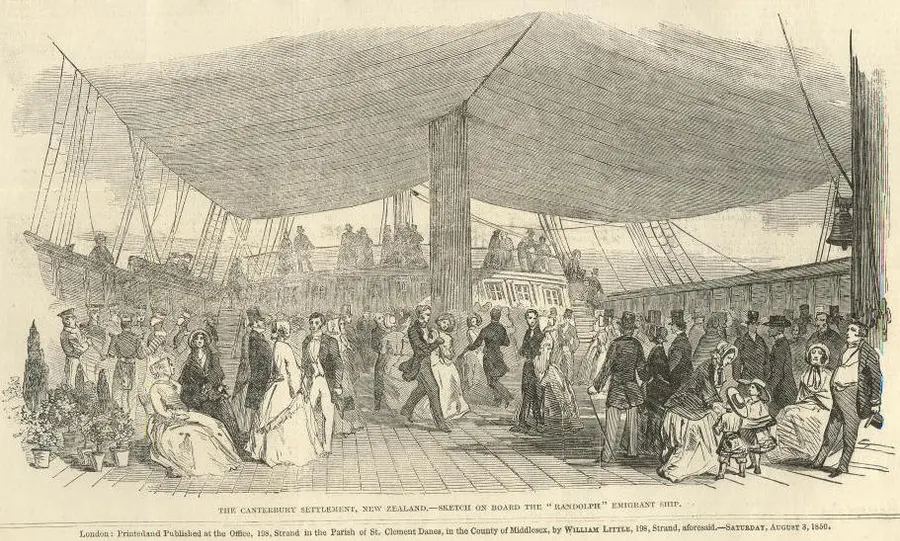
The Canterbury Association landed its first Anglican settlers at Lyttelton, the port for a planned Christchurch on the plains beyond the Port Hills.
Canterbury lies within the territory of Ngāi Tahu, the main iwi (tribe) of the South Island. Their most important pā (fortified village), Kaiapoi, was sacked by Te Rauparaha of Ngāti Toa in the early 1830s, but Ngāi Tahu kept their hold on the region. In February 1848 Governor George Grey and the New Zealand Company's Colonel William Wakefield met Ngāi Tahu chiefs at Akaroa to discuss buying land for the planned Canterbury settlement. Grey promised that if they sold, they would keep reserves 'for their present and reasonable future wants', and the government would provide schools, hospitals and general care. Commissioner Henry Tacy Kemp was sent to settle the details, and on 12 June 1848, in what Te Ara calls 'an atmosphere fraught with misunderstanding', 16 Ngāi Tahu chiefs signed his deed at Akaroa. For £2,000 the Crown took about 20 million acres. The Otago block and Banks Peninsula were separate purchases, and the northern and western boundaries of Kemp's purchase were later disputed.
The deed let Ngāi Tahu keep their settlements and food-gathering places as well as other reserves. But when Walter Mantell was sent later in 1848 to mark them out, many were reduced or ignored. Following Grey's instructions, Mantell allowed only about 10 acres a head, 6,359 acres for an estimated 637 people, and the Crown never set aside the land between the Waimakariri and Kāwari rivers that Ngāi Tahu had asked for. Meanwhile the settlers were being organised in London. The Canterbury Association, founded in 1848 and driven by Edward Gibbon Wakefield and John Robert Godley, planned a Church of England settlement drawn from all ranks of society, with churches and schools endowed from the start. Its members included two archbishops and five bishops, and Christchurch was named after Godley's Oxford college. Land would sell at £3 an acre, with two-thirds of the price going to assisted immigration, schools and the church. This was Wakefield's 'sufficient price', meant to keep new labourers working for wages for some years before they could afford land of their own.
The association's surveyor, Captain Joseph Thomas, chose the plains behind Port Cooper and laid out Lyttelton and Christchurch, but money ran short and Godley halted the works when he arrived in April 1850. The first four ships, the Charlotte Jane, Randolph, Sir George Seymour and Cressy, reached Lyttelton between 16 and 27 December 1850, the Charlotte Jane on the first day, with about 780 settlers. They were housed at first in barracks built for them, then carried their belongings up the steep bridle track over the Port Hills and down to the plains. Grey waited on board HMS Fly in what is now Governors Bay to welcome them, and Charlotte Godley wrote that her husband did not know whether to laugh or cry 'and I believe ended by doing both'.
By 1853, 3,549 settlers had arrived, about 400 of them land purchasers and the rest mostly labourers and servants. The ordered English county did not quite come about. Wool was plainly the future, and in April 1851 Godley overrode the association's tight terms for pastoral leases, letting settlement spread beyond Christchurch onto large sheep runs. Land sales fell far short and the association ran into debt; Henry Sewell came out in 1853 to wind up its affairs, and by 1855 the province had agreed to take on its debts in return for its public reserves. Ngāi Tahu began protesting almost at once. In October 1849 Matiaha Tiramōrehu of Moeraki wrote the first formal statement of their grievances: 'We shall never cease complaining to the white people who may hereafter come here.' In 1879 a chief who had been at the signing told a royal commission: 'Kemp promised us reserves, we were to have our fisheries, our burial places ... Where is the fulfilment of them?' In 1991 the Waitangi Tribunal found the Crown had failed to negotiate fairly or to provide ample reserves, and the Crown's apology was written into the Ngāi Tahu Claims Settlement Act 1998.
The defining moments of New Zealand, on one poster. Get your digital print for $25
Regions affected
Sources
Written for this project from these references rather than copied from them. Follow a link to read the full account, or to check this one against the original.
- Canterbury region
- Canterbury region – Discovery and settlement
- Canterbury region – Agriculture before 1900
- Canterbury region – Land purchased from Ngāi Tahu (map)
- Canterbury places – The Port Hills
- Canterbury places – Lyttelton Harbour
- Christchurch – A Church Settlement Foundation (1966 Encyclopaedia of New Zealand)
- Canterbury Province and Provincial District – Organised Settlement (1966 Encyclopaedia of New Zealand)
- Godley, John Robert
- Wakefield, Edward Gibbon
- Mantell, Walter Baldock Durrant
- Sewell, Henry
- Ritchie, Harriott
- Tiramōrehu, Matiaha
- Ngāi Tahu – The Ngāi Tahu claim
- Ngāi Tahu – The Ngāi Tahu settlement
- Ngāi Tahu Claims Settlement Act 1998
Related
Settlers outnumber Māori
Around 1858 settlers came to outnumber Māori for the first time. The census counted about 59,000 Europeans; rougher counts put Māori at 56,000 to 60,000, about three-fifths of their number when Cook arrived.
French settlers arrive at Akaroa
About 60 French and German settlers landed at Akaroa on Banks Peninsula in August 1840, a week after a British warship had raised the flag and held courts there. The French colony they came to found became a small French village in a British colony.
AkaroaOtago settlement founded
Free Church of Scotland settlers arrived at Port Chalmers to build a Presbyterian community, on land the New Zealand Company had bought from Ngāi Tahu in 1844 for £2,400.
DunedinNelson settlement established
The New Zealand Company’s second settlement was founded on a site with far less flat land than it had sold to its buyers.
Nelson