French settlers arrive at Akaroa
- When
- 17 August 1840
- Where
- Akaroa
- Reach
- Local
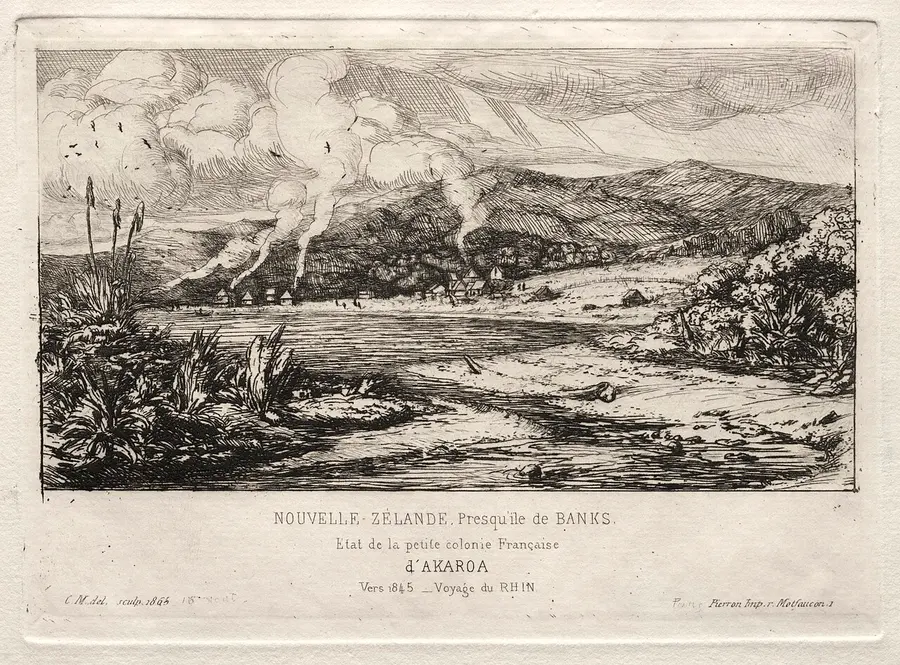
About 60 French and German settlers landed at Akaroa on Banks Peninsula in August 1840, a week after a British warship had raised the flag and held courts there. The French colony they came to found became a small French village in a British colony.
In August 1838 Jean François Langlois, captain of the French whaler Cachalot, persuaded a number of Kāi Tahu to sell him most of Banks Peninsula for 1,000 francs, about £40. A down payment of clothing and a pistol was made, with the balance to follow when the land was occupied. Back in France he found backers among merchants in Nantes and Bordeaux, who formed the Nanto-Bordelaise Company in November 1839. NZHistory describes the plan as a settlement at Akaroa that would be the nucleus of a French colony in Te Waipounamu (the South Island), linked to a penal colony in the Chatham Islands. In December 1839 King Louis-Philippe agreed to carry 80 colonists there and to send a warship ahead to protect them. Akaroa was to be renamed Port Louis-Philippe. Te Ara notes that France's true intentions for the South Island are still argued over, but that French interest clearly hurried Britain's decision to annex New Zealand.
The commander of that warship, Captain Charles François Lavaud, sailed in the corvette Aube on 19 February 1840 as the French government's commissioner, the Commissaire du Roi. The emigrant ship Comte de Paris followed from Rochefort in March, after running aground on a mudbank on the way out, loaded with animals, plants, tools, building materials and arms. Accounts of how many emigrants were aboard vary: Te Ara gives 59 and NZHistory between 50 and 60. While they were at sea the ground shifted under them. Hobson proclaimed British sovereignty over the whole country on 21 May 1840, and on 30 May the Kāi Tahu rangatira Iwikau and Hōni Tikao signed the treaty at Akaroa itself. Lavaud learned all this only when he reached the Bay of Islands in July. Hobson was friendly, but Lavaud politely declined to recognise his authority until he heard from Paris. Hobson then sent HMS Britomart south under Captain Owen Stanley, with two magistrates aboard, to show that the British were already in charge.
Britomart reached Akaroa on 10 August. Stanley raised the Union Jack, and the magistrates held British court sessions under it. The Aube came in five days after Stanley, and the Comte de Paris arrived on 17 August; Langlois' biographer says the migrants were landed at Paka-ariki Bay two days later. Lavaud soon found Langlois' title was weaker than promised. The Akaroa chiefs had not been consulted when the deed was drawn up, few of those who signed had received Langlois' later payments, and local Māori, though willing to sell, resented being occupied without payment. Lavaud promised that payment would be arranged, and Māori agreed to let the settlers stay meanwhile. The famous 'race to Akaroa' between the two warships is, in the historian A. H. McLintock's words, 'nothing more than a particularly tenacious legend'.
When Britomart left, the magistrate C. B. Robinson stayed and worked out a truce with Lavaud. The British flag was not flown on land, Lavaud administered French law to the settlers, and the Union Jack did not go up ashore again until February 1843, after Lavaud had left. The colony did well on fertile soil and trade with whaling ships, and the French navy built roads, bridges and wharves. In 1843 there were 69 French settlers, including eight Germans, alongside 86 British. The last French commissioner sailed in April 1846, ending the formal link with France. The British allowed the company four acres for every pound it could prove it had spent, and on 30 June 1849 it sold its remaining interests to the New Zealand Company for £4,500. Most settlers stayed and became naturalised. Today Akaroa's French past survives in street names such as Rue Balguerie and Rue Benoit, its cemetery and many descendants. As one French official wrote: 'It is truly regrettable that we arrived here after the British.'
The defining moments of New Zealand, on one poster. Get your digital print for $25
Regions affected
Sources
Written for this project from these references rather than copied from them. Follow a link to read the full account, or to check this one against the original.
Related
The first four ships reach Lyttelton
The Canterbury Association landed its first Anglican settlers at Lyttelton, the port for a planned Christchurch on the plains beyond the Port Hills.
LytteltonSettlers outnumber Māori
Around 1858 settlers came to outnumber Māori for the first time. The census counted about 59,000 Europeans; rougher counts put Māori at 56,000 to 60,000, about three-fifths of their number when Cook arrived.
New Zealand Company settlers land at Port Nicholson
The Aurora arrived at Petone weeks before the Treaty was signed. Flooding soon pushed the settlement across the harbour to Thorndon.
PetoneAuckland founded as the capital
Hobson moved the seat of government to the Waitematā, on land offered by Ngāti Whātua, who wanted the Crown close as protection and as a trading partner.
Auckland