New Zealand Company settlers land at Port Nicholson
- When
- 22 January 1840
- Where
- Petone · Pito-one
- Reach
- Several regions
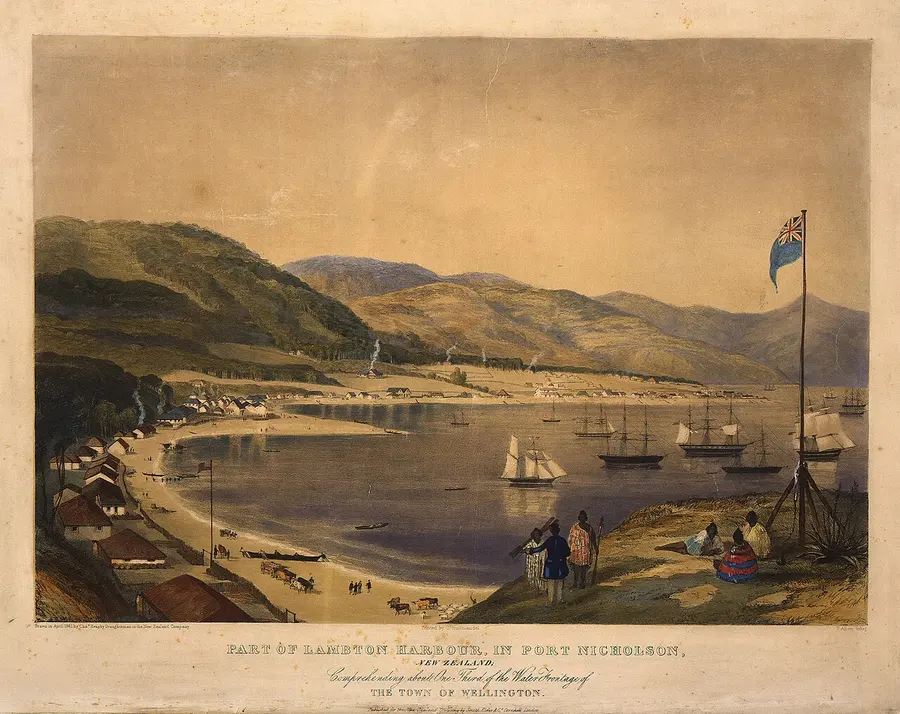
The Aurora arrived at Petone weeks before the Treaty was signed. Flooding soon pushed the settlement across the harbour to Thorndon.
Port Nicholson, the harbour Māori call Te Whanganui-a-Tara, was meant to be the first and principal settlement of the New Zealand Company, which planned to colonise New Zealand on the system devised by Edward Gibbon Wakefield. Buyers in London were sold packages of a one-acre town section and 100 country acres, and the plan for the town had 1100 town acres, drawn up without anyone having seen the ground. In September 1839 its principal agent, Colonel William Wakefield, signed a deed with the Te Āti Awa chiefs Te Puni and Te Wharepōuri at Pito-one (Petone). The Company took it to cover everything from the south coast to the Tararua Range. Te Puni's people, recent arrivals from Taranaki who feared attack by Ngāti Raukawa and Wairarapa, saw the settlers as useful allies. Chiefs at Te Aro, Pipitea and Kumutoto had taken little part, and Ngāti Toa told Wakefield that Te Āti Awa had had no right to sell.
The survey was nowhere near finished when the first immigrant ship, the Aurora, anchored off Pito-one on 22 January 1840, about two weeks before Te Tiriti o Waitangi was first signed in the north. Six immigrant ships had arrived by early in the year. Wakefield had left instructions for the town to be laid out around Lambton Harbour, on the western side, but the chief surveyor, William Mein Smith, put it on the flat land near the mouth of the Hutt (Heretaunga) River, where the plan could fit. With Māori help the settlers built huts along the beach and called the place Britannia. Te Puni's people built houses for the newcomers and traded them pork, fish and potatoes. In March Wakefield greeted three more shiploads seated in the place of honour in Te Puni's canoe.
In early March floodwaters from the Hutt swept through the makeshift town, and the Company decided to move it across the harbour to Thorndon and Te Aro. The Māori living there said no deal had been made with them and refused to give up their land. When surveyors began marking out town acres, they pulled up the pegs. Wakefield sent 20 blankets, thinking the trouble lay in how the original goods had been shared out; Māori took them as payment to stop pulling up pegs. One-tenth of the town acres were set aside for Māori, and a green belt was kept around the town, but some settlers found their sections lay inside pā (fortified villages) or were impossible to reach. The newcomers soon outnumbered their hosts: 1200 settlers had arrived by the end of 1840, and by 1843 there were 4000 Europeans around the harbour. One local chief said that had he known the 'whole tribe' meant to come, he would never have agreed. Wakefield hoped the town would be the colony's capital, but Governor William Hobson chose Auckland.
Hobson declared the earlier land sales void and set up a commission to investigate them, and in May 1842 Commissioner William Spain began hearing the Company's Wellington claim. It quickly collapsed, and with Wakefield's encouragement the inquiry turned into a matter of paying compensation instead. Spain awarded Wellington Māori £1,500 and kept their pā, cultivations and burial grounds out of the sale. Te Puni was offered only £30 and refused: 'I do not wish to grieve you but I will not take your money'. Governor FitzRoy issued a Crown grant for Wellington in July 1845, and dispute over the Hutt Valley led to fighting there in 1846. In 2003 the Waitangi Tribunal found the 1839 deed invalid, conferring no rights on the Company or its settlers. Of a block of around 209,000 acres, Māori kept only some 20,000 acres of reserves, and the promised tenths were never fully honoured. Te Āti Awa of Wellington shared in the Treaty settlement the Crown signed with Taranaki Whānui ki Te Upoko o Te Ika in August 2008. Wellington became the capital in 1865.
The defining moments of New Zealand, on one poster. Get your digital print for $25
Regions affected
Sources
Written for this project from these references rather than copied from them. Follow a link to read the full account, or to check this one against the original.
- Wellington region
- Wellington region – European arrival
- Wellington region – The struggle to survive: 1840–1865
- Te Puni-kōkopu, Hōniana
- Spain, William
- Te Rauparaha
- European settlers arrive in Wellington
- The Port Nicholson purchase
- Te Manutukutuku, issue 58: The long awaited Wellington report
- Te Āti Awa of Wellington – After 1840
Related
The New Zealand Company’s Tory reaches Port Nicholson
Edward Gibbon Wakefield’s company sent a ship to acquire as much land as it could before the Crown stopped private purchases.
Port NicholsonSettlers outnumber Māori
Around 1858 settlers came to outnumber Māori for the first time. The census counted about 59,000 Europeans; rougher counts put Māori at 56,000 to 60,000, about three-fifths of their number when Cook arrived.
French settlers arrive at Akaroa
About 60 French and German settlers landed at Akaroa on Banks Peninsula in August 1840, a week after a British warship had raised the flag and held courts there. The French colony they came to found became a small French village in a British colony.
AkaroaAuckland founded as the capital
Hobson moved the seat of government to the Waitematā, on land offered by Ngāti Whātua, who wanted the Crown close as protection and as a trading partner.
Auckland