New Zealand troops sent to the South African War
- When
- 1899–1902
- Reach
- Nationwide
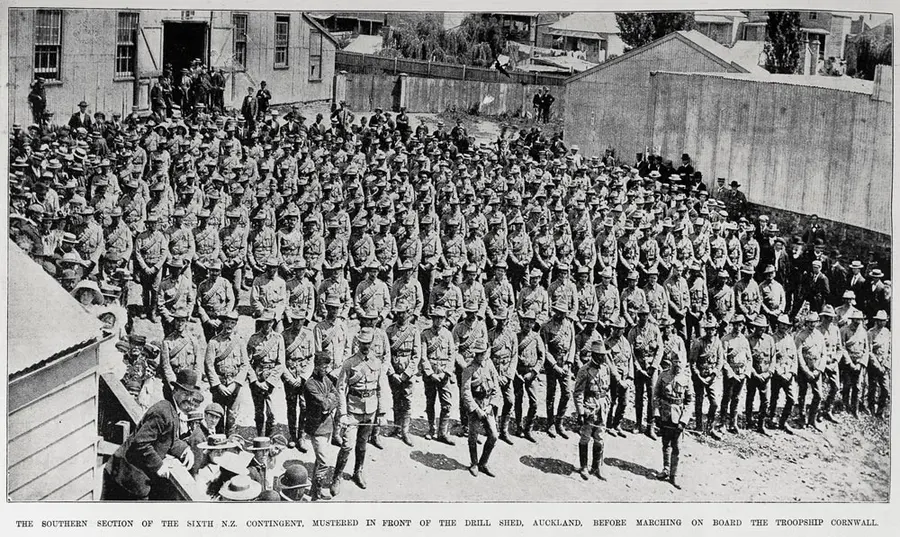
The first overseas war New Zealand fought as a country: about 6,500 men and 8,000 horses, and some 230 deaths.
The South African War was fought between the British Empire and the Boer republics of the Transvaal and the Orange Free State (the Boers were descendants of mainly Dutch settlers). The discovery of gold in the Transvaal in 1886 drew British settlers, whom the Boers refused citizenship, and a failed raid led by L. Starr Jameson in 1895 strengthened the Boers' determination to resist. On 28 September 1899, before fighting began, Premier Richard Seddon asked the House of Representatives to approve an offer of a contingent of mounted riflemen to Britain; only five members voted against it. Seddon claimed New Zealand's had been the first legislature in the empire to offer help, but NZHistory notes that five other colonies had done so in July. Te Ara says enthusiasm for the empire was at a high point, boosted within the government by concern for New Zealand's own security, and that the New Zealand and Australian governments competed to be the most imperially patriotic.
The war began in October 1899. Service in the contingent was restricted to men already in the tiny permanent force or the part-time Volunteer Force, and those accepted had minimal training at a camp at Karori in Wellington. On 21 October the First Contingent, 215 men under Major Alfred Robin, was farewelled from Wellington by a crowd of over 40,000 and sailed on the Waiwera. It reached South Africa on 23 November, several days ahead of the Australian contingents. The New Zealanders fought as mounted infantry, riding as close as possible to the enemy and then fighting on foot. On 28 December Private George Bradford died of wounds received at Jasfontein on 18 December, the first New Zealand soldier to die in an overseas conflict. On 15 January 1900 about 60 New Zealanders under Captain W. R. N. Madocks helped drive off a Boer attack at Slingersfontein, and the hill they defended was named New Zealand Hill.
In all, 10 contingents of volunteers, about 6500 men with about 8000 horses, sailed for South Africa, along with doctors, nurses, veterinary surgeons and about 20 schoolteachers. After Britain annexed the Transvaal in October 1900 the war became a guerrilla campaign. Under General Lord Kitchener, mobile columns hunted the Boer commandos (independent fighting groups), farm livestock was seized or slaughtered, and most Boer families were removed from their farms to what were soon called 'concentration camps', where disease killed many civilians. NZHistory includes a 1901 photograph of New Zealand troops burning a Boer farm. Nearly 8000 blockhouses linked by 6000 km of barbed wire were built to trap the commandos. On the night of 23 February 1902 Boers broke through a line held by 80 men of the Seventh Contingent at Langverwacht Hill; 23 New Zealanders were killed and 40 wounded. Farrier-Major William Hardham, a Wellington blacksmith, became the only New Zealander awarded the Victoria Cross in the war, for rescuing a wounded trooper under heavy fire near Naauwpoort on 28 January 1901.
The peace treaty was signed on 31 May 1902. NZHistory counts 71 New Zealanders killed in action or died of wounds, 26 killed in accidents and 133 dead of disease, more than half from typhoid; Te Ara's account of the war's memorials gives 228 dead. Māori were officially barred from serving, because the British government held that 'native' troops should not be used in a 'white man's war', although Seddon pressed for Māori to be included. About 20 Māori, generally of mixed descent, enlisted under European surnames, and Walter Callaway of Coromandel composed the war cry adopted by the contingents. At home most people backed the war, but some opposed it. The Liberal MP Robert McNab said the Boers were 'in the right', and the Christian feminist Wilhelmina Bain was widely denounced after criticising New Zealand's involvement at the 1900 conference of the National Council of Women.
Communities put up about 50 memorials to the war, all but one within six years of the peace. Most stood in main streets rather than cemeteries and carried troopers, Union Jacks and British lions; at Waimate the inscription commemorates the war in which New Zealand 'for the first time took part in the battles of empire'. The governor, Lord Ranfurly, suggested a home for returned veterans as a national memorial, and the Ranfurly War Veterans' Home opened in Onehunga, Auckland, in December 1903. The horses were not brought home but sold to local farmers and military units, and NZHistory names Major as the only New Zealand horse to come back. In NZHistory's view the war set the pattern for New Zealand's part in the two world wars, with specially raised volunteer units serving alongside other forces of the empire, and its successes fostered the idea that New Zealanders were natural soldiers who needed little training to fight well.
The defining moments of New Zealand, on one poster. Get your digital print for $25
Regions affected
Sources
Written for this project from these references rather than copied from them. Follow a link to read the full account, or to check this one against the original.
- South African War 1899–1902
- South African 'Boer' War – Origins of the conflict
- South African 'Boer' War – New Zealand's response
- South African 'Boer' War – Conditions in South Africa
- South African 'Boer' War – Key battles: 1899-1900
- South African 'Boer' War – Guerrilla war: 1901-1902
- South African 'Boer' War – Māori and the war
- South African 'Boer' War – The home front
- New Zealand answers the empire's call to arms
- Hardham wins Victoria Cross in South Africa
- Empire and Commonwealth – War and empire
- Africa and New Zealand – Colonists, soldiers and sportsmen: 1800s to 1940s
- Ngā pakanga ki tāwāhi – Māori and overseas wars – Māori and the South African War
- Memorials and monuments – Memorials to the South African War
- Horses – War
- New Zealand identity – War and sport
- Treaty of Vereeniging
- Major - the only NZ horse to return from South Africa
Related
New Zealand enters the First World War
About 100,000 served overseas from a population of just over a million. Around 18,000 died and there were some 41,000 instances of wounding or illness; no other British dominion lost a higher share of its military-age men.
The Gallipoli landing
New Zealand troops landed on the Gallipoli peninsula on 25 April. In all, 2,779 died, about one in six of those who served there. The date became the country’s day of remembrance.
Passchendaele — the worst day
An attack on Bellevue Spur in Flanders mud, against uncut wire and without effective artillery support, killed 843 New Zealanders in a few hours.
New Zealand declares war on Germany
‘Where she goes, we go’ — 140,000 served overseas and nearly 12,000 died, from a population of 1.6 million.