The Gallipoli landing
- When
- 25 April 1915 – 20 December 1915
- Reach
- Nationwide
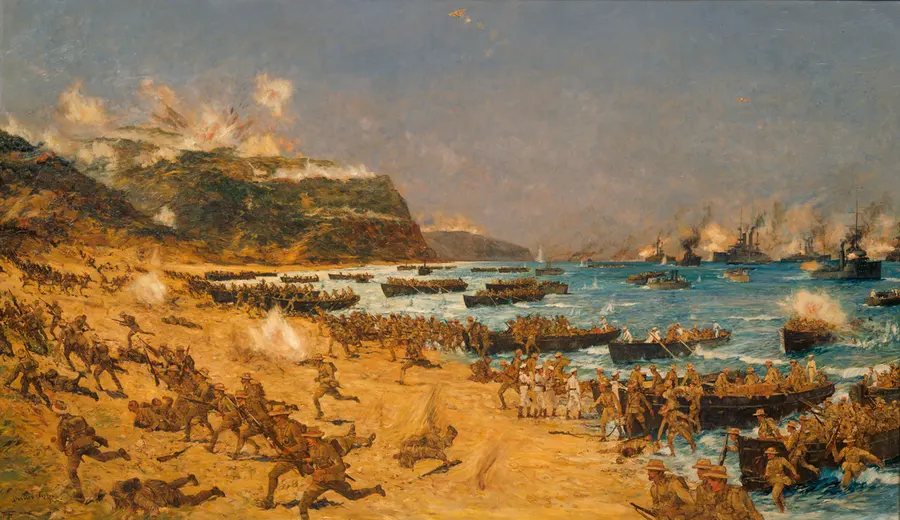
New Zealand troops landed on the Gallipoli peninsula on 25 April. In all, 2,779 died, about one in six of those who served there. The date became the country’s day of remembrance.
When war broke out between Britain and Germany in August 1914, Prime Minister William Massey pledged New Zealand's support (see New Zealand enters the First World War). The 8454-strong New Zealand Expeditionary Force (NZEF), under the British general Alexander Godley, left New Zealand on 16 October 1914, expecting to join British forces on the Western Front. When the Ottoman Empire entered the war in early November and threatened the Suez Canal, the New Zealanders and Australians were put ashore in Egypt to complete their training. Māori had at first been largely excluded, as the war was assumed to be a 'white-man's war', but a Māori contingent followed the main body and served as a garrison in Malta. On 28 January 1915 the British War Council approved an attack on the Dardanelles, the strait the Allies hoped to seize to open the way to the Ottoman capital, Constantinople (now Istanbul). After British and French warships failed to force the strait, with three battleships sunk by mines on 18 March, the Allies sent an army to capture the Gallipoli Peninsula. Australians and New Zealanders made up almost half of the 75,000 men in Lieutenant-General Sir Ian Hamilton's Mediterranean Expeditionary Force.
The landing, delayed two days by bad weather, began before dawn on Sunday 25 April 1915. While British troops made the main landing at Cape Helles on the southern tip of the peninsula, the Australian and New Zealand Army Corps (ANZAC) landed about 20 km to the north. Their boats came ashore about 2 km north of the intended site, most in a narrow bay later known as Anzac Cove, below steep ground broken by deep gullies. NZHistory thinks the most likely cause was an unauthorised change of direction by a midshipman commanding one of the steamboats towing the landing boats. The Australians went in first. New Zealand infantry, led by the Auckland and Canterbury battalions, began landing around 11 a.m. and joined the fight for Baby 700, a hill that changed hands five times that day. Ottoman reinforcements led by Mustafa Kemal (later Atatürk) pushed the Anzacs back, and that night their commanders proposed evacuation. Hamilton refused and urged them to 'dig, dig, dig until you are safe'.
The fighting settled into trench warfare, and the troops endured heat, flies, the stench of unburied bodies, insufficient water and disease. On 8 May, at Helles, the New Zealand Infantry Brigade suffered more than 800 casualties in a failed attack on the village of Krithia. In August the Allies tried to seize the heights of the Sari Bair range. On 7 August Lieutenant-Colonel William Malone refused to lead his Wellington Battalion up Chunuk Bair in daylight, saying he would not send his men 'over to commit suicide'. In the early hours of 8 August they found the summit unoccupied, took it and held it against repeated attacks. Malone was killed that evening, probably by New Zealand artillery fire, and his biographer Chris Pugsley writes that when the battalion was relieved that night some 70 of its 760 men remained. British troops who replaced the New Zealanders were driven off on 10 August. Men of the Māori Contingent took part in the offensive, the first attack by Māori soldiers outside New Zealand.
On 22 November the British decided to evacuate Anzac and the neighbouring Suvla Bay. The withdrawal from Anzac began on 15 December, with troops told they were going to Lemnos for a rest, and the last men left Anzac Cove at 4.10 a.m. on 20 December. British and French troops held Helles until 8-9 January 1916. NZHistory counts 2779 New Zealand dead, about one in six of those who served on the peninsula, and around 8000 New Zealand casualties in all; at least 87,000 Ottoman soldiers died. NZHistory concludes that the campaign had little impact on the outcome of the war. In 1925 the government unveiled a New Zealand memorial on the summit of Chunuk Bair.
News of the landing reached the governor on 29 April 1915, and four or five thousand people gathered in the grounds of Parliament. On 5 April 1916 a half-day holiday for 25 April was gazetted, and Anzac Day became a full public holiday in 1921. Returned servicemen soon claimed ownership of its ceremonies, which are modelled on a military funeral. Legislation in 1949 kept the day on 25 April whatever day of the week it fell on. NZHistory writes that for many New Zealanders 'then and since', the landings signalled that New Zealand was becoming a distinct nation, even as it fought in the name of the British Empire. More young people attended from the 1980s, and for many, being at Anzac Cove on 25 April is almost a rite of passage. New Zealand's last Gallipoli veteran, the stretcher bearer Doug Dibley, died on 18 December 1997, aged 101.
The defining moments of New Zealand, on one poster. Get your digital print for $25
Regions affected
Sources
Written for this project from these references rather than copied from them. Follow a link to read the full account, or to check this one against the original.
Related
New Zealand enters the First World War
About 100,000 served overseas from a population of just over a million. Around 18,000 died and there were some 41,000 instances of wounding or illness; no other British dominion lost a higher share of its military-age men.
Passchendaele — the worst day
An attack on Bellevue Spur in Flanders mud, against uncut wire and without effective artillery support, killed 843 New Zealanders in a few hours.
New Zealand troops sent to the South African War
The first overseas war New Zealand fought as a country: about 6,500 men and 8,000 horses, and some 230 deaths.
New Zealand declares war on Germany
‘Where she goes, we go’ — 140,000 served overseas and nearly 12,000 died, from a population of 1.6 million.