The raid on Maungapōhatu
- When
- 2 April 1916
- Where
- Maungapōhatu
- Reach
- Local
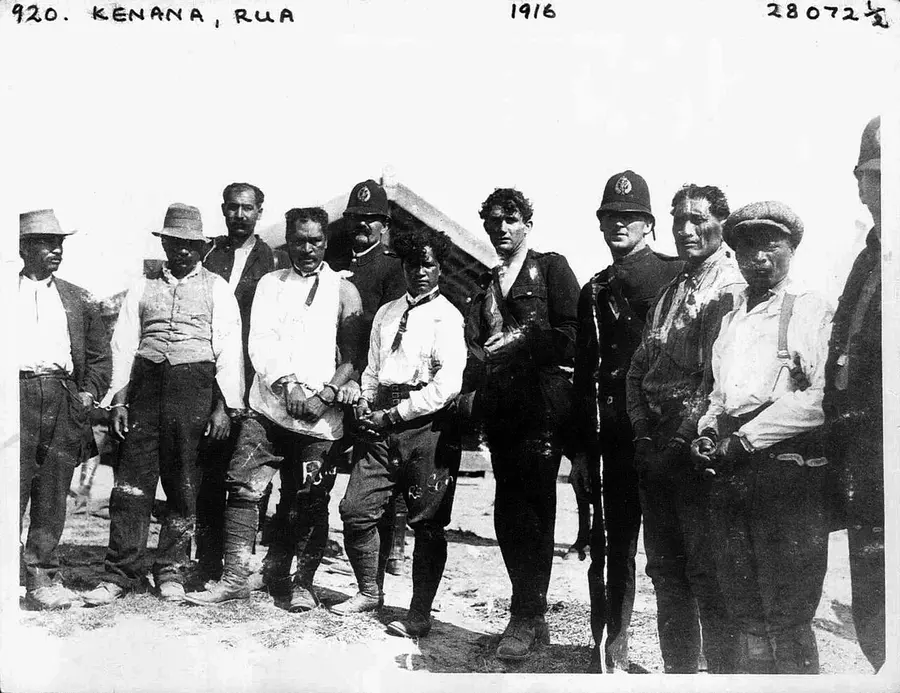
An armed police expedition marched into the Tūhoe prophet Rua Kēnana’s community at Maungapōhatu in Te Urewera to arrest him. Two men were shot dead, including Rua’s son.
Rua Kēnana, of Ngāi Tūhoe, was born in 1868 or 1869. After Te Kooti, the founder of the Ringatū Church, died in 1893, Rua claimed to be the successor, named Hepetipa (Hephzibah), whom Te Kooti had prophesied would complete his work by regaining the land. His claim divided the church, but many Tūhoe saw him as a symbol of a new era in which their lost lands would be returned. In 1907 he began building a 'city of God' at the foot of Maungapōhatu, the mountain sacred to Tūhoe; Te Ara puts its population at around 600. His followers called themselves Iharaira (Israelites). The government was suspicious of Rua, and the Tohunga Suppression Act 1907 was aimed mainly at him (see Tohunga Suppression Act), although he was never charged under it. After meeting the prime minister, Sir Joseph Ward, in 1908, he flew a Union Jack stitched with the words 'Kotahi te ture mō ngā iwi e rua Maungapōhatu' (One law for both peoples, Maungapōhatu). Harsh winters, poor diet and poor housing took a heavy toll, and by 1913 the community had shrunk to about 30 families.
During the First World War Rua counselled against Māori volunteering, and his biographer Judith Binney writes that his leadership came to be seen as seditious. In May 1915 he was convicted on liquor charges and served a prison sentence. In January 1916 he was summoned on the 1915 convictions and asked for the case to be put off while he harvested his crop. The magistrate treated this as contempt, and a warrant was issued committing him to prison. When two constables brought it to him on 12 February, Rua told them he had already been punished and would not go with them, and they did not force him. Binney writes that the native minister, William Herries, urged on by the Tūhoe chief Kererū, decided to use these legal channels to remove Rua. On 9 March the commissioner of police, John Cullen, began preparing an armed expedition.
The police reached Maungapōhatu on Sunday 2 April 1916. Accounts of their numbers differ: NZHistory says 57 police; Te Ara's biography describes 57 constables sent secretly from Auckland plus two smaller contingents from Gisborne and Whakatāne; the Rua Kēnana Pardon Act 2019 says 70 armed men. Rua was seized while standing unarmed on the marae, waiting to greet them, and at that moment a shot was fired. In the gunfight that followed, Rua's son Toko and another young man, Te Maipi, were killed. Three other residents and four police officers were wounded, and 31 Maungapōhatu men were arrested and held for up to three days. Binney found that senior officers later orchestrated police evidence that a Māori had fired first in a planned ambush. In her view the weight of evidence supports the Māori account of a police shot, although the matter is unlikely ever to be settled, and Toko, wounded after he grabbed a gun and fired at the police, was probably summarily executed.
Rua was taken to Auckland with five other prisoners on 5 April. His trial in the Supreme Court lasted 47 days, the longest in New Zealand history before 1977. The jury rejected the sedition charge and could not agree on two others, but found him guilty of 'morally' resisting arrest in February. The judge, F. R. Chapman, sentenced him to one year's hard labour followed by 18 months' imprisonment (the Police Gazette recorded the second part as reformative detention), saying Māori needed to learn that the law 'reached every corner' of the land. Eight of the jurors publicly protested against the harshness of the sentence. The charges against the five men arrested with Rua were dropped in September 1916, after they had spent several months in prison.
Rua was released in April 1918 to a community burdened with legal costs, including the cost of the police expedition, which he was expected to pay. In 1922 Tūhoe gave 40,000 acres (16,000 hectares) to the government in exchange for roads to Maungapōhatu that were never built, and by 1930 most of the people had left. Rua died at Matahī on 20 February 1937. The Waitangi Tribunal later found that the police used excessive force against the community and that Rua's arrest was unlawful because it was made on a Sunday. The Rua Kēnana Pardon Act 2019, which received the royal assent on 21 December 2019, pardons him for 'moral resistance' to arrest. In it the Crown 'unreservedly apologises' to his descendants and to Ngā Toenga o Ngā Tamariki a Iharaira, his Iharaira followers, and records that the Maungapōhatu community 'has never recovered'.
The defining moments of New Zealand, on one poster. Get your digital print for $25
Regions affected
Sources
Written for this project from these references rather than copied from them. Follow a link to read the full account, or to check this one against the original.
Related
The 28th (Māori) Battalion
Te Hokowhitu-a-Tū
A volunteer battalion organised by tribal area fought in Greece, Crete, North Africa and Italy. Its casualty rate was almost 50% above the average for New Zealand infantry battalions.
Te Kooti escapes from Rēkohu
Deported without trial, Te Kooti seized a schooner and brought nearly 300 prisoners home from Rēkohu. Colonial and Māori forces pursued him for almost four years and never caught him.
Gisborne and Te UreweraThe influenza pandemic
About 9,000 people died in two months — roughly half as many as died in four years of war. Māori died at more than eight times the Pākehā rate.
The attack at Matawhero
Te Kooti and about a hundred men attacked the settlement at Matawhero overnight. Sources put the dead at between about 50 and 70, Māori and Pākehā, among them women and children.
Matawhero