Passchendaele — the worst day
- When
- 12 October 1917
- Reach
- Nationwide
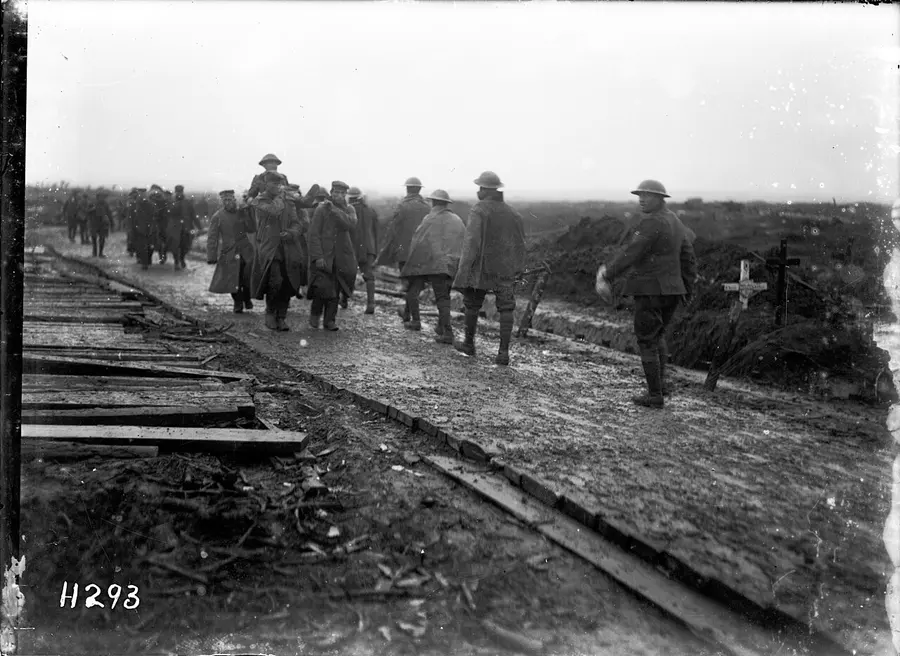
An attack on Bellevue Spur in Flanders mud, against uncut wire and without effective artillery support, killed 843 New Zealanders in a few hours.
In 1916 the emphasis of New Zealand's war effort shifted from the fight against the Ottoman Empire (see The Gallipoli landing) to Europe. The New Zealand Division, commanded by Major-General Andrew Russell, went to France in April 1916. On 7 June 1917 it captured the village of Messines in Belgium in a carefully prepared attack, but by the time it was relieved on 9 June it had suffered 3700 casualties, including 700 dead. Messines was the prelude to General Haig's main offensive, the Third Battle of Ypres, which began on 31 July 1917. Haig hoped to break through the German lines on the higher ground around the town of Ypres in Flanders, and the prospect of neutralising German submarine bases on the Belgian coast added to the plan's appeal in London. Heavy rain soon turned the battlefield into a morass. Haig then turned back to General Sir Herbert Plumer, who from 20 September used 'bite and hold' tactics: limited advances kept within range of artillery support, so that German counter-attacks could be broken up by gunfire.
The New Zealand Division made its first attack on 4 October 1917, taking Gravenstafel Spur, one of two spurs on the ridge above the village of Passchendaele. The men advanced 1000 m and took more than 1000 prisoners. NZHistory says some 500 men were killed or mortally wounded; Te Ara puts the cost at 340 New Zealand lives. The British high command concluded, wrongly, that German resistance was faltering. A British and Australian attack on 9 October collapsed, but Haig pressed on with the last of five planned blows three days later. The New Zealanders were to take Bellevue Spur, and the 4th Australian Division was to take Passchendaele itself. In the thick mud it was almost impossible to bring heavy guns forward or to stabilise those already in position, and no systematic bombardment of the German barbed wire or concrete pillboxes had been made.
Zero hour on 12 October was 5.25 a.m. The barrage opened with a roar but soon became ragged or petered out, and many of the first shells fell among the waiting New Zealand infantry. The men moved off in drizzle that soon turned to driving rain. On the right, 2nd Brigade ran into barbed wire that sloped across its front; a few determined men got through and were quickly killed, and most of the rest took cover in shell holes. Machine guns on the spur fired into the attackers from the front and the flank. A further push ordered for 3 p.m. was cancelled at the last moment, and the troops fell back to positions close to their start line. Many badly wounded men died in the mud before they could be reached. Over the next two days an informal truce, in which Germans held their fire on stretcher parties, helped rescuers bring the wounded out.
NZHistory counts about 2700 New Zealand casualties, including about 950 men dead or mortally wounded; 843 are officially listed as dying on 12 October. Te Ara calls it the worst fiasco in New Zealand's military history and the highest one-day death toll suffered by New Zealand forces overseas. Russell wrote: 'It is plain we attacked a strong position, stoutly defended with no adequate preparation.' His biographer Chris Pugsley blames the failure mainly on the ineptitude of the corps commander Alexander Godley's staff, and calls Russell's admission a rare example of a commander accepting responsibility. Canadian troops relieved the Anzacs on 18 October and occupied the ruins of Passchendaele village on 6 November, at a cost of 12,000 casualties. Haig closed the battle down on 20 November with only part of the ridge taken, and within months all the ground gained was back in German hands.
In terms of lives lost in a single day, NZHistory describes 12 October 1917 as the blackest day in New Zealand's post-1840 existence. The 1176 New Zealanders named on the Memorial to the Missing at Tyne Cot Cemetery in Belgium include at least five sets of brothers. In 1925 a railway locomotive, AB 608, was named Passchendaele in memory of New Zealand Railways staff who fell in the war; restored to working order, it has run in First World War centenary commemorations. An NZHistory teaching resource notes that while Gallipoli has long held centre stage in national commemoration, it was on the Western Front that most New Zealanders fought and died, and asks why Passchendaele goes largely unnoticed in the New Zealand calendar.
The defining moments of New Zealand, on one poster. Get your digital print for $25
Regions affected
Sources
Written for this project from these references rather than copied from them. Follow a link to read the full account, or to check this one against the original.
Related
The Gallipoli landing
New Zealand troops landed on the Gallipoli peninsula on 25 April. In all, 2,779 died, about one in six of those who served there. The date became the country’s day of remembrance.
New Zealand enters the First World War
About 100,000 served overseas from a population of just over a million. Around 18,000 died and there were some 41,000 instances of wounding or illness; no other British dominion lost a higher share of its military-age men.
New Zealand troops sent to the South African War
The first overseas war New Zealand fought as a country: about 6,500 men and 8,000 horses, and some 230 deaths.
New Zealand declares war on Germany
‘Where she goes, we go’ — 140,000 served overseas and nearly 12,000 died, from a population of 1.6 million.